
Septic Tank Replacement Cost in Fontana, CA: Size, Material, and Soil Factors
If you just bought your first home on septic in Fontana, CA, the phrase septic tank replacement cost probably showed up in your inspection report or a late-night search. This guide walks you through, step by step, how to figure out what a replacement would actually cost on your property by examining the septic replacement cost factors—size, material, and soil conditions—that drive the price more than anything else.
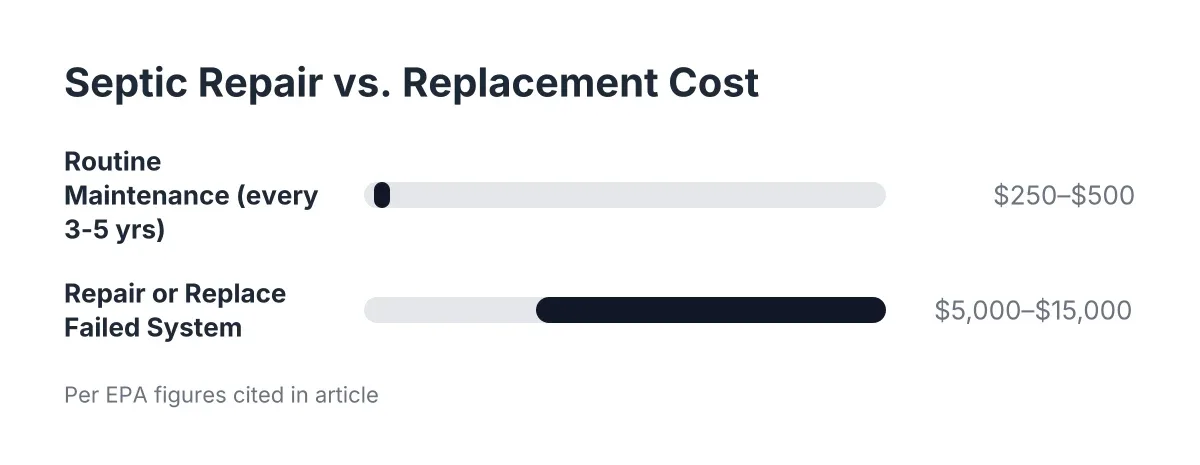
For context, the U.S. Environmental Protection Agency puts the cost to repair or replace a failed conventional system at $5,000 to $15,000, while routine maintenance runs $250 to $500 every three to five years. That gap is the whole story. The steps below show you where your property lands inside that range, and how to keep from ever needing the big number.
Step 1: Confirm the Tank Actually Needs Replacement
Start by finding out whether you need a new tank at all. Plenty of first-time septic owners get told "the tank needs attention" and assume that means replacement. Often it means a pump-out, a new baffle, or a riser repair, all of which cost a fraction of a full replacement.
A tank generally needs replacement when it has structural problems, not just a backup or a slow drain. The common triggers are cracks in the tank body, often from vehicles driving over it or from age-related brittleness, a collapsed lid, or a tank so corroded it no longer holds its shape.
Before you accept a replacement quote, get a septic system inspection from a local septic tank inspector. Have them open the tank, pump it, and look at the walls and baffles with the sludge out. A cracked baffle is a repair. A cracked tank wall below the water line is usually a replacement. Knowing the difference is the single biggest way to avoid paying thousands you did not need to spend.
What Are the Signs of Septic System Failure and Replacement Needs?
A failing septic system in Fontana usually shows itself through slow drains throughout the house, sewage odors near the tank or leach field, wet or unusually green patches of grass over the drain field, and sewage backing up into tubs or floor drains. One slow drain is often a clog. Several at once points to the tank or the field.
However, these symptoms do not tell you which part failed. A full tank, a blocked line, and a saturated drain field all look similar from inside the house. That is why the inspection comes before any talk of replacement cost, and understanding these signs matters when assessing septic replacement cost factors.
Step 2: Size the Tank to Your Home, Not to a Guess
Next, figure out what size tank your house requires, because tank size is the first cost factor you can pin down. Bigger tanks cost more to buy, more to haul, and more to set, and the county decides the minimum, not you.
San Bernardino County Department of Public Health sets minimum tank capacities by bedroom count: a 3-bedroom home requires at least a 1,000-gallon tank, and a 5-to-6-bedroom home requires 1,500 gallons. If you bought a 3-bedroom house with an old undersized tank, a replacement must meet today's standard, which can push the price up even though you are "just swapping tanks."
Count your bedrooms as the permit office will count them, including that converted den a previous owner called an office. Then price tanks at the required capacity, not the capacity of the old one in the ground.
Step 3: Compare Tank Materials and What Each Costs
Then weigh your material options, because the tank itself is one of the clearest line items in a septic tank replacement cost estimate. In this area you will mostly see two choices:
- Concrete tanks. Heavy, durable, and often cheaper than a poly tank of the same size. They need a truck with a boom to set, and they can crack with age or vehicle traffic, but a sound concrete tank lasts decades.
- Plastic (poly) tanks. Lighter and easier to place on tight or hard-to-reach lots. They resist corrosion, but they can cost more than concrete at the same capacity and must be bedded and backfilled carefully to avoid deformation.
Material choice interacts with your site. A backyard tank with no truck access may favor a lighter poly tank even at a higher material price, because the alternative is craning a concrete tank over the house. On an open lot with good access, concrete is often the lower-cost path. According to the International Code Council, tank shapes and configurations also vary by region; some areas use rectangular concrete tanks and others circular ones, so match the replacement to what your system and county approval call for.
Step 4: How Soil and Site Conditions Drive Septic Replacement Cost Factors
Now look down, because soil and site conditions are where replacement budgets go sideways. Two identical 1,000-gallon tanks can carry wildly different installed prices depending on what sits between the surface and the hole.
The site factors that move the cost of a septic tank replacement the most:
- Soil type and drainage. A percolation test measures how well your soil drains, and according to University of Nebraska-Lincoln Extension, it must be performed before installing a septic system. Poor-draining soil can force a larger or redesigned drain field.
- Rock. Hitting rock during excavation means more machine time, sometimes specialty equipment, and a bigger bill.
- Depth and slope. A shallow, gently sloped, gravity-fed layout is the cheap scenario. Deep tanks, steep grades, or a house sitting below the field add cost fast.
- Pump requirements. If wastewater cannot flow downhill to the tank and field, you need a pump chamber and pump system, which raises the price well above a straightforward gravity replacement.
- Access. Fences, pools, mature trees, and tight side yards all add labor hours.
Here is an illustrative scenario. Say a first-time buyer in north Fontana has a 3-bedroom home with an open side yard, sandy soil that drains well, and a gravity-fed layout. Their replacement might land near the low end of the EPA's $5,000 to $15,000 range. Suppose a neighbor on a sloped lot hits rock at three feet and needs a pump chamber. That job could push toward the top of the range or past it, with the same size tank. The tank did not change; the dirt did.
Step 5: Check Whether the Leach Field Is Part of the Job
Before you sign anything, find out if the quote covers the tank alone or the whole system. According to the U.S. Environmental Protection Agency, a conventional septic system has two main components: the septic tank and the drain field. After the tank clarifies wastewater, perforated pipes spread the liquid through the leach field, where gravel, sand, and soil finish the filtering.
Therefore, a "tank replacement" quote may be half the picture. If the drain field is saturated or clogged with solids, replacing only the tank buys you a short reprieve before the backups return. A leach field inspection tells you whether the field still accepts water or whether you are looking at field repair or replacement on top of the tank.
Homeowners also underestimate relocation. Moving a tank to a new spot sounds simple until you price re-plumbing the house line and possibly redesigning the drain field to match the new location. If a contractor suggests relocating the tank, ask for those items as separate line items so you can see the full septic tank replacement cost before committing.
Step 6: Get Local Quotes and Read Them Line by Line
With size, material, and soil questions answered, collect quotes from local Fontana septic companies, not national dispatch lines. A real quote for a replacement should break out:
- The tank itself, at the county-required capacity
- Permit fees and county health department coordination
- Excavation, including any rock or depth allowances
- Risers, lids, baffles, and connection fittings
- Backfill, compaction, and site cleanup
- Drain field work, if any, listed separately
Compaction matters more than it sounds. According to Onsite Installer, the fill around the pipe penetrations must be compacted thoroughly after the tank is set, or settling can damage the connection and cause leaks at the one joint you cannot see. A quote that skips backfill and compaction details is a quote worth questioning.
One trade-off to be honest about: the cheapest bid is not automatically the wrong one, and the highest is not automatically padded. However, a bid that does not mention permits or a perc test for field work is missing required steps, and the gap will show up later as change orders. When bids disagree sharply, a second independent septic system inspection is cheap insurance; this is also a point where county requirements get specific, so a professional should confirm anything structural.
Step 7: Protect the New System So You Never Repeat This
Finally, once the new tank is in, put it on a maintenance schedule. This is the part of septic system basics that saves the most money over time. The EPA's own math makes the case: $250 to $500 in maintenance every three to five years, versus $5,000 to $15,000 for a failed system.
How Often Should I Pump My Septic Tank?
Most households should pump the septic tank every three to five years, and according to Penn State Extension, an active family of four should plan on a pump-out every two to three years because of higher solids and water use. Your first pump-out also doubles as a checkup; the septic pumper sees the tank empty and can flag problems early.
Between pump-outs, watch your water. The U.S. Environmental Protection Agency notes that a single running toilet can waste as much as 200 gallons per day, and all of that water lands in your tank and leach field. Skip harsh chemical drain cleaners, keep grease out of the sink, and never drive or park over the tank or field.
Septic is less common here than in much of the country; EPA data puts California's septic use at about 10% of homes, compared to 55% in Vermont. That means fewer Fontana neighbors can give you hand-me-down advice, and it makes a straightforward local septic company worth finding before anything goes wrong, not after.
The Short Version for Fontana, CA Homeowners
Replacement cost comes down to three questions. How big a tank does the county require for your bedroom count? Which material fits your lot and access? What is hiding in your soil? Answer those with an inspection and a perc test instead of a guess, and the quote in front of you will finally make sense. Better yet, pump on schedule and the full replacement bill may stay a number you only ever read about.
If you need septic tank pumping, Fontana Septic can help.
Prefer to talk it through? Call (909) 316-2368 — a quick call is usually the fastest way to get a straight answer for your situation.