
Septic Tank Pump Replacement — Complete Guide
Your septic system may rely on a mechanical pump to move wastewater where gravity cannot, and when that pump quits, everything backs up fast. This guide covers septic tank pump replacement from end to end: how to tell whether the pump itself has failed, what a replacement actually costs, and where the line sits between a DIY fix and a job for a licensed crew. You will also learn what an effluent pump does, why it fails, and why "pumping the tank" and "replacing the pump" are two very different projects. If you are a Fontana homeowner staring at an alarm light or a sluggish drain, the next few sections will help you make a fast, informed decision.
What You'll Find in This Guide
- Septic Tank Pump Replacement Terms Explained: A Plain-English Glossary
- How Much Does Septic Tank Pump Replacement Cost?
How a Septic Pump Works and Why It Fails
Not every septic system has a pump. In a conventional gravity system, wastewater flows downhill from your house to the tank and then out to the leach field on its own. However, many Fontana properties sit on lots where the leach field is uphill from the tank, or where the soil requires a pressure-dosed distribution system. In those cases, an effluent pump sits in the tank or in a separate pump chamber and pushes liquid out to the drain field on a timed or float-triggered cycle.
That pump is a hardworking piece of equipment. It cycles on and off dozens of times a day, sits submerged in effluent year-round, and often runs for a decade or more before anything goes wrong. Eventually, though, something does. Floats stick, impellers clog with solids that should never have reached the pump chamber, and motors burn out. Additionally, electrical problems like a tripped breaker or a corroded splice can mimic a dead pump, which is why a proper diagnosis matters before you buy anything.
Warning Signs Your Pump Is on Its Way Out
The most common signal is the alarm. Most pump-assisted systems include a high-water alarm that sounds or lights up when effluent rises above the level the pump should maintain. Beyond that, watch for slow drains throughout the house, gurgling fixtures, sewage odors near the tank lids, or unusually wet ground over the pump chamber. If the pump runs constantly without shutting off, that also points to trouble, either with the pump itself or with a float switch that no longer reads the water level correctly.
Household habits play a role too. For example, a single leaky or running toilet can waste as much as 200 gallons of water per day, according to the U.S. Environmental Protection Agency. That extra volume forces the pump to cycle far more often than it was designed to, which shortens its life. With this in mind, part of any good pump diagnosis includes a look at what is flowing into the tank, not just what is failing to flow out. If the vocabulary on your inspection report reads like a foreign language, our plain-English glossary of pump replacement terms translates it.
What Septic Tank Pump Replacement Really Costs
The price question is usually the first one homeowners ask, and it deserves a straight answer. Unfortunately, most websites dodge it with a vague range. In practice, the cost of replacing a septic pump depends on three variables: the type of pump your system uses, how hard the pump chamber is to access, and whether the pump failed alone or dragged other components down with it. Our full septic pump replacement cost guide walks through each variable with real numbers, so you can sanity-check any quote you receive.
A basic effluent pump swap in an accessible chamber sits at the low end. However, costs climb quickly when the failure involves a grinder pump, a buried or hard-to-reach chamber, damaged floats and wiring, or a control panel that needs replacement. The worst-case scenario is a pump that failed silently weeks ago and flooded the leach field with solids. At that point, you are no longer pricing a pump. You are pricing field repair.
Why Waiting Costs More Than Acting
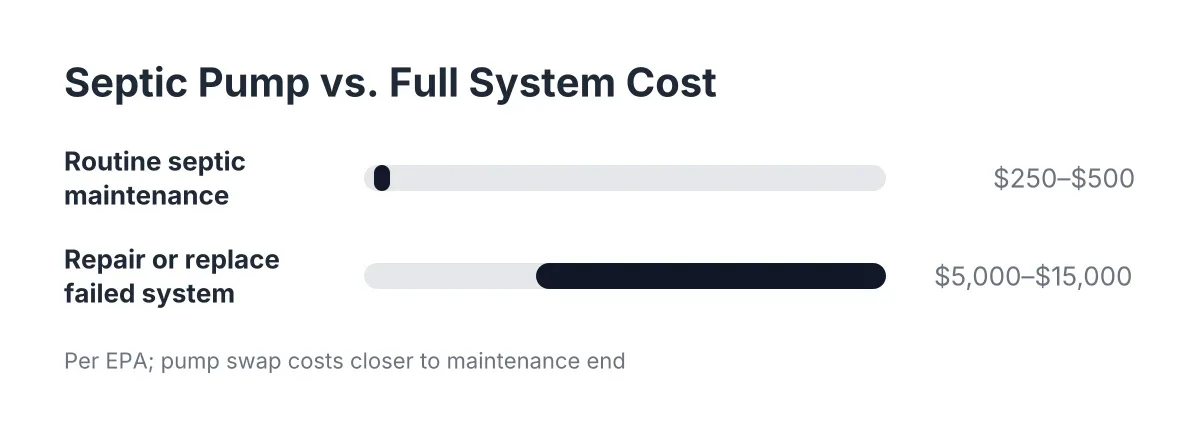
Delay is the most expensive decision you can make with a failing pump. The EPA reports that regular septic maintenance runs $250 to $500 every three to five years, while repairing or replacing a failed conventional system costs $5,000 to $15,000. A dead pump left running against a clog, or ignored until the tank overflows, is exactly how a few-hundred-dollar problem becomes a five-figure one. As a result, we treat pump failures as urgent calls, and our trucks carry common replacement effluent pumps so most swaps happen in a single visit.
Tank size affects cost planning too. In San Bernardino County, the Department of Public Health requires a minimum 1,000-gallon tank for a 3-bedroom home and 1,500 gallons for a 5-6 bedroom home. Larger tanks and larger households mean larger pumps, longer pump run times, and more wear. To put it simply, know your tank size and pump type before you compare quotes, because a price for the wrong pump is not a real price.
Can You Pump or Replace a Septic Tank Pump Yourself?
This is where two very different questions get tangled together, so let's separate them. The first question is whether you can pump out a septic tank yourself, meaning remove the accumulated sludge and scum. The second is whether you can replace the mechanical pump yourself.Additionally, the answers are different, and both come with real limits.
Pumping the Tank Yourself: Why It Rarely Makes Sense
Pumping a tank means extracting a thousand gallons or more of raw sewage and hauling it somewhere legal. That requires a vacuum truck, not a rented trash pump, and California requires licensed haulers to transport and dispose of septage at approved facilities. Renting a small pump to move sewage into your yard, a ditch, or a storm drain is illegal and creates a genuine health hazard. Beyond the legal problem, a homeowner pumping their own tank misses the inspection that comes with professional service. A trained tech checks baffles, measures sludge depth, and spots early pump and field problems while the tank is open. That inspection is a large part of what you are paying for. The EPA's SepticSmart program is a solid resource if you want to understand what proper tank maintenance involves.
DIY Septic Tank Pump Replacement: Where the Line Sits
Replacing an effluent pump is more plausible as a DIY project, but only in narrow circumstances. If your pump chamber has an accessible riser, the pump connects with a union fitting and a plug rather than hardwired splices, and you are confident working around sewage gases and electricity, a handy homeowner can swap a like-for-like pump. That said, the risks are real. Pump chambers produce hydrogen sulfide and methane, and people die every year from entering septic tanks. Never climb into a tank or chamber, period. Additionally, an incorrectly sized pump, a miswired float, or a bad check valve can flood your leach field or burn out the new pump within months.
In practice, most Fontana homeowners who call us mid-project hit one of three walls: the old pump is seized to corroded piping, the floats and control panel also failed, or the replacement pump they bought does not match the system's head height and flow requirements. Matching pump specs matters more than brand, and it is the step DIY replacements most often get wrong. If you attempt the swap, at minimum have the tank inspected first so you know the failure was actually the pump.
Choosing the Right Replacement Pump for Tank Pump Replacement Success
If the diagnosis confirms a dead pump, the next decision is what goes back in the chamber. Effluent pumps, sewage ejector pumps, and grinder pumps look similar in photos but do very different jobs. An effluent pump moves clarified liquid from the tank's outlet chamber to the drain field. A sewage ejector handles raw waste with solids up to about two inches. Meanwhile, a grinder pump shreds solids into slurry for pressurized lines. Installing the wrong category is the fastest way to a repeat failure.
Matching Specs, Not Just Horsepower
Horsepower gets the attention, but two other specs matter more. First, total dynamic head: the vertical lift plus friction loss your pump must overcome to push effluent to the field. Second, flow rate: the gallons per minute your system's dosing design expects. For example, an oversized pump can dose the leach field too fast and erode the distribution network, while an undersized one runs constantly and dies young. The correct replacement matches your system's design, and that design lives in your county permit records or a prior inspection report. Our glossary of septic pump terms defines head, dosing, floats, and the other specs you will see on pump labels.
Availability matters too, especially during a failure. Septic systems are relatively uncommon in California, at about 10% of homes according to EPA data, so big-box stores in the area stock a limited pump selection. As a result, homeowners often settle for whatever is on the shelf, which is how mismatched pumps end up in Fontana tanks. Because we work on septic systems every day, our crews carry the common effluent pump sizes on the truck, so a diagnosis and a correct replacement usually happen in the same visit. However you source the pump, insist on a written spec match before anyone installs it. A pump that fits the pipe is not the same as a pump that fits the system.
Ready to Get Started?
If your pump alarm is sounding or your drains are backing up, you need a diagnosis today, not a callback from a distant dispatch center. Call our Fontana crew directly and talk to someone who works on septic pumps every day and carries replacements on the truck. One visit gets you an honest answer, a firm price, and in most cases a working pump before we leave.