
Concrete Septic Tank Pumping: What a Landlord Should Expect During Service
If you own rental homes around Fontana, odds are at least one of them sits on a concrete tank. Concrete septic tank pumping is mostly the same job as pumping any other tank, but concrete comes with its own checkpoints. The material cracks, the baffles fail, and the lids are heavy. A crew that knows concrete looks for specific problems while the tank is open, and that look is worth as much as the pump-out itself. Understanding what a concrete septic tank inspection involves is essential for protecting your investment.
This guide walks through what concrete septic tank pumping involves, what it should cost, when your rentals need it, and what a crew should check inside the tank while it is empty. If you manage two or more properties on septic, the goal here is simple: help you set a schedule, understand the invoice, and stop fielding surprise calls from tenants.
Why Concrete Tanks Get Their Own Conversation
Most older homes in the Fontana area that run on septic have concrete tanks. Concrete is heavy, durable, and buried, which is exactly why problems hide. A plastic tank flexes and shows damage in obvious ways. A concrete tank can crack along a seam, lose a baffle, or wear thin at the waterline, and the system keeps limping along until a tenant calls about a backup.
Septic tank shapes vary by region too. According to the International Code Council, some areas use rectangular concrete tanks while others use circular ones. Around San Bernardino County, rectangular two-compartment concrete tanks are common on older rental stock. Two compartments means two lids, and both chambers need to be pumped. If a pumper only opens one lid, half the solids stay in the tank.
The practical point for a landlord: concrete tanks reward a crew that pumps and inspects in the same visit. The tank has to be empty before anyone can see the walls and baffles anyway, so the smart move is to bundle the look with the pump-out instead of paying twice.
Related reading: Concrete Septic Tank Durability: Lifespan, Maintenance, and How It Compares to Plastic.
How Often Rental Properties on Septic Need a Pump-Out
A rental home on septic generally needs pumping every two to three years when a full household lives there. According to Penn State Extension, an active family of four produces enough solids and wastewater that pumping every two to three years is advisable. Tenant households often run heavier than owner households, so landlords should lean toward the shorter end of that range.
Here is the part that catches multi-property owners: usage varies unit to unit. A duplex with four adults on one side and a single tenant on the other loads the shared tank unevenly. Tank size matters as well. San Bernardino County's minimum capacity table requires a 1,000-gallon tank for a 3-bedroom home and 1,500 gallons for a 5-to-6 bedroom home, according to the San Bernardino County Department of Public Health. An older rental may have a tank sized for fewer bedrooms than the home now has.
Therefore, the best approach across several properties is a staggered recurring schedule. Put each address on its own clock based on tank size and occupancy, then let the septic service track the dates. One landlord-side spreadsheet plus a pumper who sends reminders beats waiting for a tenant to report a slow drain.
Watch for these signs between scheduled visits:
- Slow drains in more than one fixture at the same property
- Gurgling from toilets or tubs after laundry runs
- Sewage odor near the tank lids or over the drain field
- Wet, soft, or unusually green ground above the leach field
- Any backup into the lowest drain in the house
Any one of these means the tank is overdue or something else in the system is failing. For a landlord, a backup is not just a plumbing problem; it can become a habitability complaint. Scheduled pumping is cheaper than that conversation.
How Much Does It Cost to Pump Out a Septic Tank?
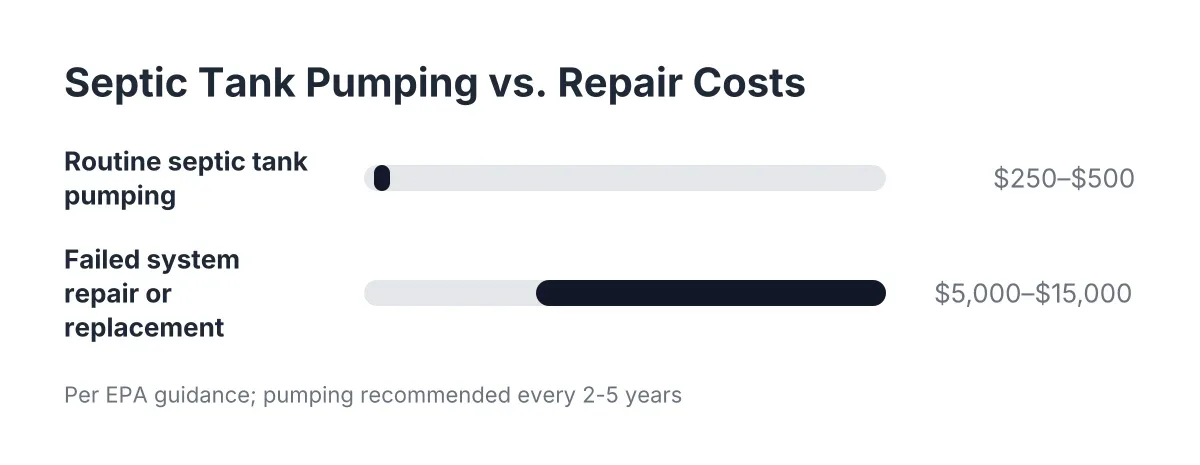
Pumping a residential septic tank typically runs in the range of a few hundred dollars per visit; EPA guidance puts regular septic maintenance at $250 to $500 every three to five years, according to the U.S. Environmental Protection Agency. The price for a given tank depends on size, access, how full it is, and how long since the last pump-out.
As of 2026, that $250 to $500 band is still a reasonable planning number for a standard pump-out in the Fontana area, though every property is its own case. When you search phrases like "septic tank pumping near me prices," remember that the lowball quote often covers only the liquid. Removing liquid alone is not a real pump-out. The settled sludge at the bottom and the floating scum layer at the top are what cause problems, and both must come out.
A few things push the price up on a concrete tank:
- Locating and digging. If the lids are buried under a foot of soil or a tenant's planter box, someone has to find and uncover them.
- Heavy solids. A tank that skipped its last cycle takes longer to pump and may need extra water to break up the sludge.
- Two compartments. Both chambers get pumped and rinsed, which takes more time than a single-chamber job.
- Access. The truck needs to park within hose range of the tank, on ground that will hold its weight.
Now set that cost against the alternative. The U.S. Environmental Protection Agency puts the cost of repairing or replacing a failed conventional system at $5,000 to $15,000. For a landlord with shared systems on a duplex or small building, replacement can mean vacancy, permits, a percolation test, and county health department sign-off. A few hundred dollars every two to three years per unit is the cheapest line item in your maintenance budget relative to what it prevents.
What Happens During Concrete Septic Tank Inspection and Pumping
A proper pump-out on a concrete tank follows a sequence, and each step exists for a reason. If you have never watched one at your property, here is what a thorough crew does.
Step 1: Locate and uncover the tank
First, the crew finds the tank and exposes the lids. On older Fontana-area rentals, the lids are often buried, and nobody wrote down where. Locating the tank before digging avoids damaging pipes, the lid, or the yard. A good crew also records the location so the next visit starts faster. For a landlord, ask for that location note in writing; it belongs in your property file.
Step 2: Check the ground before the truck moves in
Next, the technician walks the approach and confirms the ground will hold a loaded pump truck. This matters after rain, on soft lawns, and on long gravel drives. A stuck truck turns a one-hour job into an afternoon. An experienced operator checks this personally rather than taking anyone's word for it.
Step 3: Pump both the sludge and the scum
Then the actual pumping starts. The hose goes in and the crew removes everything: liquid, the sludge blanket at the bottom, and the scum mat on top. On a two-compartment concrete tank, both chambers get cleaned out. A thorough crew rinses the tank interior with a water hose afterward so the walls are visible for inspection. How long to pump out a septic tank depends on volume and solids, but a routine residential job usually wraps in under an hour once the lids are open.
Step 4: Haul the waste to a treatment plant
Finally, the waste leaves with the truck. Pumped septic waste is transported to a sewage treatment plant for disposal rather than processed on-site, according to the New Hampshire Department of Environmental Services. Nothing gets dumped on your property or anywhere near it.
The Inspection a Concrete Tank Deserves While It Is Empty
An empty tank is the only honest view you will ever get of your system. This is the core reason concrete septic tank pumping and inspection belong in the same visit: once the sludge is out, a septic tank inspector can see and photograph the walls, the seams, and the baffles. Paying separately for an inspection later means paying for another pump-out first, since you cannot inspect through three feet of sewage.
Here is what the crew should check on a concrete tank while it is open:
- Baffles. The inlet and outlet baffles direct flow and keep solids out of the drain field. On older concrete tanks, the baffles are often concrete themselves, and they erode or break off. A missing outlet baffle sends solids straight to the leach field, which is how drain fields die.
- Cracks and seams. Concrete cracks over time, especially at the seam where the lid meets the tank body or where the two halves join. Cracks let groundwater in and sewage out.
- The waterline. Sewage gases attack concrete above the waterline. The crew should look for soft, flaking, or pitted concrete near the top of the tank.
- Inlet and outlet pipes. The outlet must sit lower than the inlet, since solids float and only liquid should exit toward the drain field, as the University of Nebraska-Lincoln Extension explains. The crew should confirm both pipes are intact and flowing.
- Pump chamber, if present. Some systems include a concrete septic tank with a pump chamber that lifts effluent to the drain field. If your property has one, the float switches and pump deserve a check while everything is accessible.
Ask for photos of the tank interior with the invoice. For a landlord, those photos are documentation: proof of maintenance for your records, evidence for a future sale or refinance, and a baseline if a tenant dispute ever touches habitability. A one-line receipt that says "pumped tank" documents nothing.
One honest limitation: a pump-out inspection tells you about the tank, not the whole system. If the crew sees effluent flowing back into the tank from the outlet, or the drain field shows surface wetness, you need a leach field inspection as a separate evaluation. Drain field problems are a different diagnosis, and repair or replacement decisions on a shared system for multiple units deserve a professional assessment before you spend capex money.
A Realistic Schedule for a Multi-Property Owner
Suppose you own a duplex in Rialto, a three-bedroom rental in Highgrove, and a small house near Colton, all on concrete tanks. Three properties, three clocks, three sets of tenants who will call you first when a drain slows down.
In that scenario, a workable plan looks like this:
- Pump and inspect all three in year one. This establishes a baseline: tank condition, baffle status, lid locations, and photos for each address.
- Set each property's interval from what the crew found. The duplex with four adults might go on a two-year cycle. The lightly occupied Colton house might stretch to three.
- Stagger the dates. Spreading visits across the year smooths your cash flow instead of stacking three invoices in one month.
- Keep one file per property. Invoice, photos, tank location, and any noted concerns. When a unit turns over, you know the system's condition before a new lease starts.
- Give tenants one instruction. Report slow drains and gurgling early. A slow drain report costs you a phone call; a backup costs you a cleanup, a habitability headache, and sometimes a rent credit.
In addition, tell tenants what not to flush and fix running toilets fast. A single leaky or running toilet can waste as much as 200 gallons of water per day, according to the U.S. Environmental Protection Agency, and all of that water lands in the tank and drain field. On a shared system, one bad flapper valve in one unit shortens the pump-out interval for the whole building.
Should I Use Additives Like Rid-X in My Septic?
Additives are not a substitute for pumping a septic tank, and most systems do not need them. The bacteria that digest waste arrive in the waste itself. No additive removes the sludge and scum that build up at the bottom and top of the tank; only a pump truck does that.
For a landlord, the math is straightforward. Monthly additive costs across several units add up, and the tanks still need pumping on the same schedule. Regular septic tank pumping is the single most effective thing you can do to extend the life of a system. Spend the maintenance budget there, not on treatments that do not change the pump-out interval.
Grease is the other quiet system killer, especially in multi-unit properties where several kitchens feed one tank. Research published in the International Journal of Environmental Science and Technology estimates that 30 to 40 percent of sewer clogs trace back to fat, oil, and grease deposits. If a property has a grease trap, put its cleaning on the same recurring calendar as the pump-outs.
Where to Find Septic Tank Pumping Services Near Fontana
Fontana-area landlords can find septic pumping companies near them through local search, but the better filter is how the company operates. California runs on municipal sewer more than most states; EPA data shows about 10 percent of California households use septic, among the lowest rates nationally. That means fewer local crews focus on septic as their main work, and plenty of listings route your call to a dispatch center far from San Bernardino County.
For a multi-property owner, the shortlist test is practical:
- Do they answer with a person who can talk about your specific tanks, or a script?
- Will they pump and inspect in the same visit, with photos?
- Can they put your properties on a recurring schedule and send reminders?
- Do they know the local soil, county requirements, and older concrete tank quirks around Fontana, Rialto, Colton, and Highgrove?
- Will the paperwork support your accounting, one clean invoice per address?
A local septic service that works these neighborhoods every week knows where the old tanks sit shallow, which streets flood the yards in a wet winter, and what the county health department expects if a system ever needs repair work. That knowledge shows up in fewer surprises on your invoice and fewer calls from your tenants.
The Bottom Line for Concrete Septic Tank Pumping and Inspection
Concrete septic tank pumping done right is a pump-out plus an inspection, performed together while the tank is empty. Both chambers cleaned, baffles checked, walls photographed, waste hauled to a treatment plant, and a record left in your file. On a two-to-three year cycle per property, it is a predictable few hundred dollars that protects you from a five-figure system replacement and the vacancy that comes with it.
Set the schedule once, stagger the dates across your properties, and let the crew carry the calendar. The whole point of owning rentals on septic without losing sleep is that the tank gets pumped before anyone has a reason to call you about it.
If you need septic tank pumping, Fontana Septic can help.
Prefer to talk it through? Call (909) 316-2368 — a quick call is usually the fastest way to get a straight answer for your situation.