
What to Ask a Septic Pumping Contractor Before Hiring One in Fontana
If you own rental homes on septic in Fontana, one bad pump-out can cost you a tenant. The questions you ask a septic pumping contractor before hiring tell you more than any ad or directory listing ever will. A good local septic pumper answers them in plain language over the phone. A call center reads a script and stalls. This FAQ covers the questions worth asking, the answers you should expect, and the red flags that mean you should keep dialing.
Why do the questions you ask a septic pumping contractor matter so much?
The questions you ask a septic pumping contractor separate a straightforward local crew from a dispatch service that resells the job. A pumper who knows the work will answer cost, timing, and disposal questions directly. If you get vague answers or a hard sell, the job will probably go the same way.
This matters more if you manage several properties. A landlord juggling three rentals in the Fontana area cannot afford to re-shop a septic company every time a tenant reports a slow drain. Ask the right questions once, and you can hand every property to one crew and stop scrambling.
How much does it cost to pump out a septic tank?
Septic tank pumping for a typical residential tank usually runs in the low-to-mid hundreds of dollars, with the final price depending on tank size, access, and local demand for pump trucks. Pricing in any area is shaped by how many pump trucks serve how many septic homes, so Fontana prices will not match national averages.
For context, San Bernardino County's minimum capacity table requires a 1,000-gallon tank for a 3-bedroom home and 1,500 gallons for a 5-6 bedroom home, according to the San Bernardino County Department of Public Health. A bigger tank holds more waste, so it costs more to pump.
When you ask about the cost of septic tank pumping, listen for what the quote includes. Ask these questions directly:
- Does the price cover locating and uncovering the tank lid, or is digging extra?
- Is pumping both compartments of the tank included?
- Are disposal fees built in or added later?
- What triggers an extra charge, such as a hard-to-reach tank or extra hose runs?
A contractor who answers all four without hesitation is quoting a real price, not a teaser.
How often should a septic tank be pumped?
Most household septic tanks need a pump-out every three to five years, and busy households need it more often. According to Penn State Extension, an active family of four should generally pump every two to three years because of higher solids and water use. Rental homes with full occupancy fall into that busier category.
In addition, some localities set required pump-out intervals by rule, not by tank condition. Check what applies to your parcel rather than relying on a general rule of thumb. A local septic tank inspector can also check the sludge level and tell you whether you can wait another year.
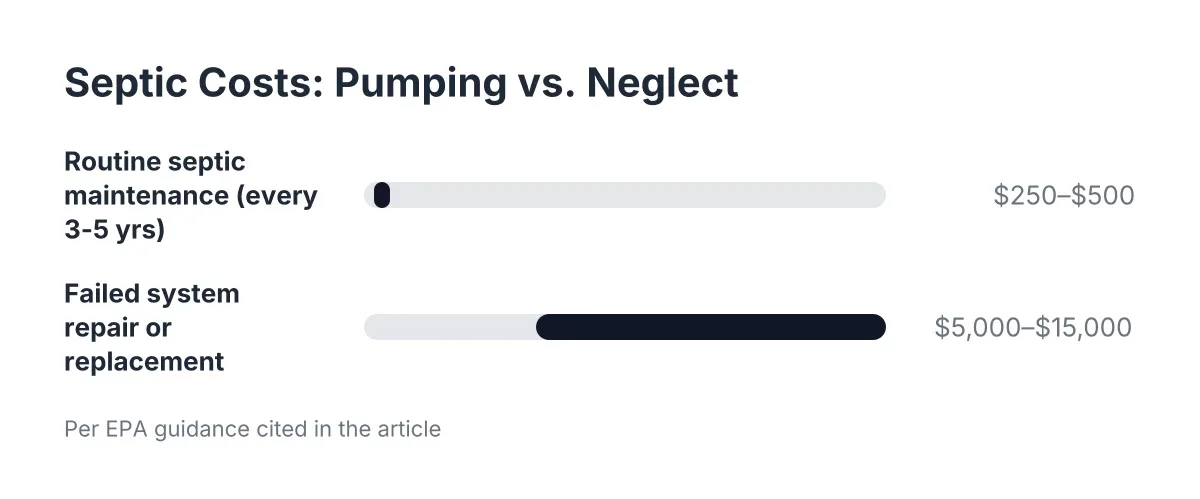
Skipping the schedule is the expensive path. EPA guidance puts routine septic maintenance at $250 to $500 every three to five years, versus $5,000 to $15,000 to repair or replace a failed conventional system, according to the U.S. Environmental Protection Agency.
What should you ask a septic pumping contractor about disposal and paperwork?
Ask the septic pumping contractor where the waste goes and what documentation you get after the job. Pumped septic waste is hauled by truck to a treatment facility for disposal, not handled on site, according to the New Hampshire Department of Environmental Services. A legitimate pumper can name the facility that accepts their loads.
Paperwork matters just as much for a landlord. A dated service record with the tank size, sludge condition, and any problems noted gives you documentation for accounting and proof of maintenance if a tenant ever files a habitability complaint. If a contractor cannot provide a simple record of the pump-out, that is a reason to keep looking.
What happens during a septic pumping visit?
A proper pumping visit starts with locating and uncovering the tank, because digging blind risks damage to lids and pipes. The crew then pumps out sludge and liquid, checks the baffles and tank condition, and tells you what they found. The whole visit usually takes an hour or two for a standard home.
Before the truck even parks, a careful technician checks that the ground is solid, especially after rain. A heavy pump truck stuck in a soft yard turns a routine pump-out into a mess. Little habits like that are a sign of a crew that has done this work for a long time.
For example, suppose you own a three-bedroom rental near Sierra Avenue and the tenant reports a slow drain in both bathrooms. A typical crew would ask when the tank was last pumped, locate and open the lid, measure the sludge, and pump the tank. If the drain field is the real problem, pumping alone will not fix it, and an honest contractor says so on the spot instead of taking your money quietly.
Is pumping the same as cleaning, and do I need both?
Pumping and cleaning both refer to removing waste from the tank, but the terms get used loosely. A pump-out should remove the sludge and scum layers along with the liquid, not just skim the easy liquid off the top. Skimming leaves solids behind and shortens the time until your next backup.
Therefore, ask the contractor directly: do you remove the full contents including sludge, and do you pump both compartments? A clear yes to both is the answer you want.
Should I use Rid-X or other additives in my septic tank?
Septic additives are not a substitute for regular pumping. No product dissolves the solids that build up in a tank; only a pump truck removes them. A healthy tank already contains the bacteria it needs from normal household waste.
However, this is a fair test question for a contractor. A septic pumper who pushes additives hard instead of a sensible pump-out schedule is selling product, not service. Customers reasonably expect a pumper to act as a general septic resource, able to talk through odors, backups, drain field concerns, and pumping frequency; a good one welcomes those questions.
What should a landlord with multiple rentals ask before committing?
A landlord should ask whether the company can put several properties on one recurring pumping schedule with reminders, so no tank gets forgotten. One company covering all your Fontana-area rentals means one call when a tenant reports a backup, one set of records, and predictable costs instead of emergency pricing.
Ask these before you commit:
- Can you track pump-out dates for multiple addresses and remind me when each is due?
- Will I get a written service record per property for my files?
- Do you handle inspection and leach field work too, or only pumping?
- Who answers the phone when a tenant calls about a slow drain, a local crew or a dispatch center?
That last question is the one most landlords skip. A company that routes calls through distant dispatch cannot tell you which truck is near your Valley Boulevard duplex. A local Fontana crew can.
One honest limitation: a pumper is not an installer. Designing and installing a new system requires separate licensing and knowledge of soil types, percolation rates, and local regulations, according to the New Hampshire Department of Environmental Services. If a rental's drain field has failed, a pump-out buys time, but you will need engineered repair work and county involvement.
Where can I find septic tank pumping services near Fontana, CA?
Fontana homeowners and landlords can find septic pumping through local septic companies that serve Fontana and its immediate surrounding area, rather than national directories that route calls elsewhere. Searching "septic pumper near me" returns plenty of listings, but many are lead brokers with no truck of their own. The questions in this article are how you tell the difference.
As of 2026, septic systems serve a minority of California homes; EPA data puts the state's septic use rate at about 10%, among the lowest in the country, according to the U.S. Environmental Protection Agency. That means fewer crews truly specialize in this work, so when you find a local pumper who answers every question above without flinching, keep their number. For a landlord, that one contact is worth more than any directory.
If you need septic tank pumping, Fontana Septic can help.
Prefer to talk it through? Call (909) 316-2368 — a quick call is usually the fastest way to get a straight answer for your situation.