
Common Leach Field Mistakes That Turn a Fixable Problem Into a Replacement
Most leach fields that get dug up and replaced did not fail overnight. They failed slowly, and often a homeowner's own habits sped it along. The common leach field mistakes we cover here are the ones that turn a field that could have been saved into a field that has to come out. If you own a septic-dependent property in or around Fontana, knowing these mistakes matters more than knowing any repair method, because the cheapest repair is the one you never need.
This is written as a straight FAQ. Short questions, direct answers, no runaround.
How does a leach field work, and why does it fail?
A leach field, also called a drain field, is the soil absorption half of your septic system. According to the U.S. Environmental Protection Agency, a conventional septic system has two main components: the tank that clarifies wastewater and the drain field that disperses the clarified liquid into the ground. The field is built as perforated pipes set in gravel, buried under soil, as described by the US EPA.
The field fails when more reaches it than the soil can handle. Most failures trace back to one of two overloads. Hydraulic overload means too much water volume hits the field. Biological overload means too many solids, grease, or organic material slip past the tank and clog the gravel and soil pores. Nearly every one of the common leach field mistakes below feeds one of those two overloads.
What are the most common leach field mistakes homeowners make?
The most common leach field mistakes are skipping routine pump-outs, sending too much water to the system, flushing grease and non-degradable items, and driving or building over the field. Each one pushes the field toward clogging or compaction. None of them show symptoms right away, which is why they do so much damage.
Here is the short list a septic pumper sees over and over:
- Skipping tank pump-outs until a backup forces the issue
- Ignoring a running toilet or leaky fixture that floods the field with clean water
- Pouring grease, fats, and cooking oil down the drain
- Flushing wipes, hygiene products, and other non-degradable waste
- Parking vehicles, pouring concrete, or building sheds over the field
- Planting trees or deep-rooted shrubs near the leach lines
- Routing gutters, pool backwash, or water softener discharge onto the field
- Waiting months after the first slow drain or odor to call anyone
Any one of these can shorten a field's life. Two or three together can finish off a field in a few years instead of decades.
Why does skipping pump-outs destroy a leach field?
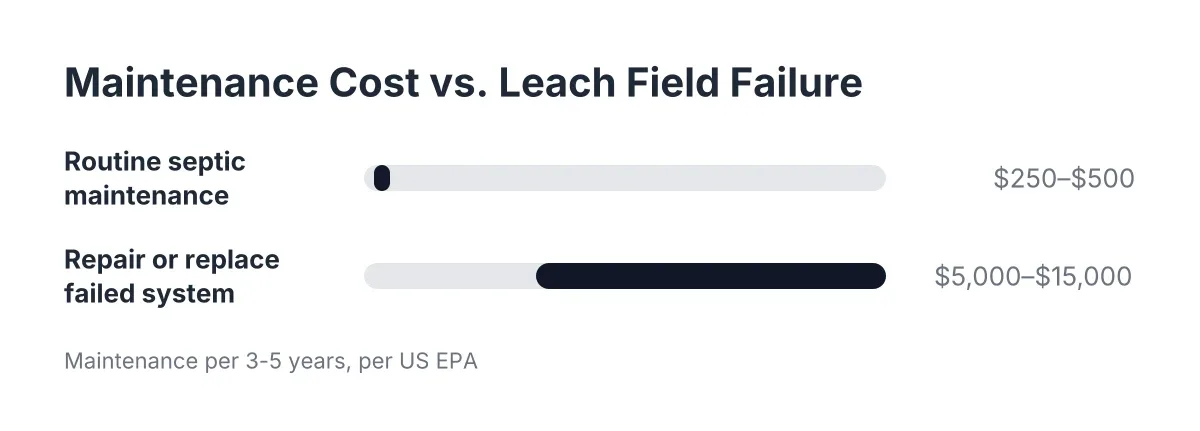
Skipping septic tank pumping lets the sludge layer in the tank rise until solids wash out into the leach lines. Once solids coat the gravel and soil, the field stops absorbing water, and pumping the tank afterward will not undo it. The EPA puts the stakes plainly: maintenance runs $250 to $500 every three to five years, while repairing or replacing a failed conventional system runs $5,000 to $15,000, according to the U.S. Environmental Protection Agency.
Here is the part most people miss. The tank is replaceable plumbing; the field is soil, and soil does not recover on a schedule. Once a field clogs with non-degradable waste, the usual fix is not a pump-out but excavating and replacing the leach lines. That is the expensive outcome regular pumping exists to prevent.
Can too much water really damage the field?
Yes, excess water is one of the fastest ways to damage a leach field. The soil under the field can only absorb so many gallons per day; push past that and wastewater pools instead of filtering. According to the U.S. Environmental Protection Agency, a single leaky or running toilet can waste as much as 200 gallons of water per day, all of it flowing straight to your field.
In addition, habits stack up. Back-to-back laundry days, long showers, and an irrigation head soaking the field area all count. A saturated field cannot treat sewage, so every extra gallon makes the clog worse and the recovery slower.
What should never go down the drain on a septic system?
Grease, fats, oils, wipes, and anything that does not break down should never go down a drain on a septic system. Grease is a proven line-killer; EPA's report to Congress found grease is the most common cause of reported sewer blockages, at 47 percent. In a septic system, that same grease rides out of the tank and seals the soil in your field.
Wipes labeled flushable, paper towels, and hygiene products do not digest in the tank. They build the sludge layer faster, which shortens your pump-out interval and raises the odds solids reach the field. Scrape pans into the trash, keep a jar for cooking oil, and treat the toilet as a one-purpose fixture.
Is it a mistake to drive or build over the leach field?
Driving or building over a leach field is one of the costliest mistakes a homeowner can make. Vehicle weight compacts the soil and can crush the perforated pipes or septic chambers buried below. Concrete slabs, sheds, and additions block oxygen from reaching the soil, and soil bacteria need that oxygen to treat wastewater.
For example, suppose a homeowner on a half-acre Fontana lot pours an RV pad without checking where the leach lines run. The pad sits over two of four lines. Within a couple of years the remaining lines are doing double duty, the yard over them turns soggy, and what began as a parking decision becomes an excavation estimate. A quick leach field inspection before the pour would have moved the pad twenty feet and cost nothing in damage.
What about trees and landscaping over the field?
Trees and deep-rooted shrubs are a mistake near leach lines; roots find the moisture in the pipes and grow into them. Root intrusion is a common root cause behind full drain field replacement, especially when the field was undersized for the house to begin with. Keep trees well away from the field, and the bigger the species, the farther away it belongs.
However, a bare dirt field is not the goal either. Many homeowners assume nothing can grow there, when shallow-rooted grasses and drought-tolerant groundcovers are fine and help the field shed rainwater. If the grass over the field is noticeably taller or greener than the rest of the yard, treat that as a warning sign, not a bonus; it usually means excess moisture and nutrients are surfacing.
What are the signs a leach field is already in trouble?
Signs of leach field failure include slow drains throughout the house, sewage odor in the yard, soggy or spongy patches over the field, and that stripe of unusually green grass. Repeated backups after a recent pump-out point at the field, not the tank. Gurgling fixtures after laundry or showers are an early version of the same message.
Therefore, act on the first symptom, not the third. A field caught early may respond to lighter measures; a field that has pooled sewage for months usually will not. Delay is itself one of the common leach field mistakes, and it is the one that most reliably turns a repair into a replacement.
Can a failing leach field be repaired, or does it always need replacing?
A failing leach field can sometimes be repaired, and the answer depends on what an inspection finds in the lines themselves. A key diagnostic step is exposing the leach lines away from the tank and checking whether they hold standing water or run dry, and whether roots are inside. Saturated lines with clean pipe suggest overload that may recover once the load drops; root-packed or solids-clogged lines usually mean replacing those runs.
This is where leach field repair differs from tank work, and where a local septic crew earns its keep. A clogged inlet baffle, for instance, is a common cause of backups and should be among the first things checked, according to the Washington State Department of Health; fixing it costs a fraction of touching the field. Diagnosing which problem you have requires digging and judgment, so this is a job for a professional, not a weekend project.
I'm building on vacant land near Fontana. How do these mistakes apply to a new system?
New construction is where leach field mistakes get baked in permanently. Before anything is installed, a percolation test must be dug and performed to confirm how well the soil drains, according to University of Nebraska-Lincoln Extension; counties require it for good reason. An undersized field relative to the house is a mistake no amount of maintenance fixes later.
During installation, details matter. Lines need adequate fall from the tank, checked before digging starts, and each line needs to run level so wastewater disperses along the whole trench instead of pooling at the low end. Fill around the pipe penetrations at the tank should be compacted to prevent settling, a point made by Onsite Installer. As of 2026, local health departments in the Fontana area still inspect these systems before sign-off, so a system built right the first time passes without rework and keeps your build on schedule.
What happens if I just ignore a struggling field?
Ignoring a struggling leach field guarantees the most expensive outcome. Untreated sewage either backs up into the house or surfaces in the yard, which is a health risk to your family and anyone downhill. The field keeps clogging the whole time, so the repair bill grows while you wait.
The pattern to remember is simple. The mistakes in this article all compound quietly, and the field rarely gives you a second warning. Pump the tank on schedule, keep water use and grease in check, keep weight and roots off the field, and call a local septic system inspection crew at the first slow drain. That routine is what keeps a Fontana leach field working for decades instead of becoming a trench project.
If you need septic tank pumping, Fontana Septic can help.
Prefer to talk it through? Call (909) 316-2368 — a quick call is usually the fastest way to get a straight answer for your situation.