
Leach Field Replacement vs. Repair in Fontana, CA: How to Know Which One You Need
If your drains are slow and the yard over your drain field stays wet, you are facing the leach field replacement repair question every septic owner dreads. Here is the honest answer up front: some fields can be saved, and some cannot. The difference comes down to what is actually wrong underground, and most companies skip the diagnostic work that tells you. This guide walks homeowners in Fontana, CA through the decision step by step, so you know whether a repair will hold or you are just paying to delay a replacement.
If you just bought your first home on septic and the inspection report flagged the drain field, this is for you. Follow the steps in order. Each one narrows down whether the field can be rehabilitated or needs to come out.
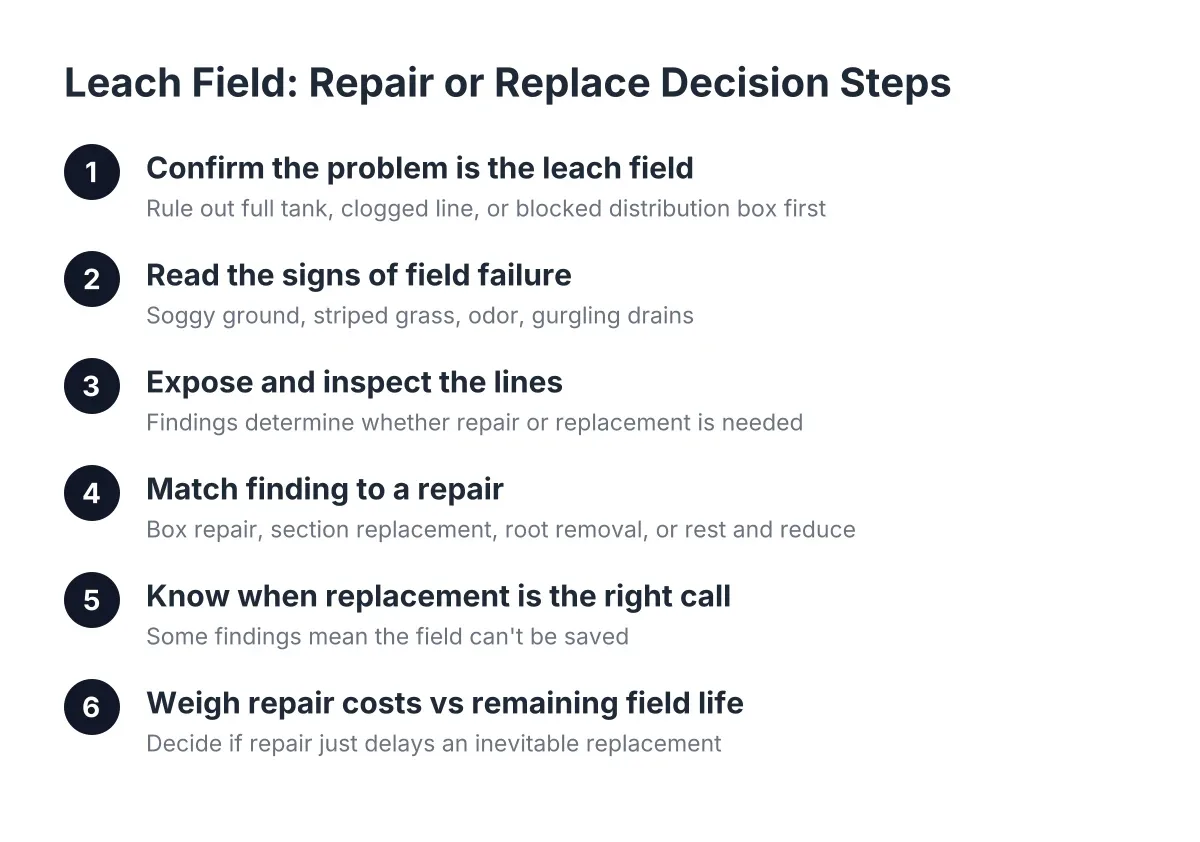
Step 1: Confirm the Problem Is Actually the Leach Field
Before you spend anything on leach field work, rule out the cheaper causes. A backup or slow drain can come from a full septic tank, a clogged line between the house and the tank, or a blocked distribution box. None of those require touching the field.
Start with these checks, in order of cost:
- Pump the tank. If the tank has not had a pump-out in five or more years, solids may have filled it. A pump-out is the cheapest fix on the list. If drains run fine for months afterward, the field is probably not the problem.
- Check for a running toilet or leak. According to the U.S. Environmental Protection Agency, a single leaky or running toilet can waste as much as 200 gallons of water per day. That volume alone can flood a healthy field and mimic failure.
- Inspect the distribution box. According to Penn State Extension, the distribution box evenly splits wastewater from the tank into the leach field lines. A tilted or clogged box sends all the flow to one line, which then looks failed while the rest sit unused.
However, if the tank was pumped recently and symptoms returned within days or weeks, the field itself is the likely suspect. Move to Step 2.
Step 2: Read the Signs of Leach Field Failure
A failing field announces itself. The classic signs are soggy or spongy ground over the trench lines, grass that grows greener and faster in stripes above the field, sewage odor in the yard, and gurgling drains inside the house. Standing gray water on the surface means the soil can no longer absorb what the tank sends out.
Timing matters here. A field that gets mushy only after heavy winter rain may just be waterlogged soil, not a dead field. A field that stays wet through a dry Fontana summer is telling you the soil underneath is sealed or saturated.
Do not wait on this. Wastewater surfacing in the yard is a health hazard for your family and pets, and the problem compounds. Every week a saturated field keeps receiving flow, more solids push into the gravel and soil, and the odds of saving it drop.
Step 3: Get the Lines Exposed and Inspected Before Anyone Quotes Replacement
This is the step most skipped, and it is the one that decides everything. The deciding diagnostic is simple: expose a section of the leach lines away from the tank and look inside. What the crew finds determines the repair path.
- Standing water in the lines, no roots: the soil or the gravel-soil interface is clogged with biomat. Rehabilitation may be possible.
- Root debris packed in the pipe: roots from nearby trees found the moisture. Cutting roots and repairing crushed sections can restore flow, often without replacing the whole field.
- Dry lines with surfacing water elsewhere: points to a broken or collapsed pipe, or a distribution box sending flow to one spot. A section repair may be all you need.
- Lines full of solids: the tank passed sludge into the field, usually from years of missed pump-outs. This is the worst finding. Once solids infiltrate the gravel bed, that section generally cannot be cleaned out and must be replaced.
A proper leach field inspection in Fontana, CA should include probing or exposing the lines, checking the distribution box, and measuring water levels in the tank. If a company quotes full replacement over the phone without looking underground, get a second opinion. The whole point of a real leach field inspection is to find out which of these four situations you have, because the price difference between them is enormous.
Step 4: Match the Finding to a Repair, If Repair Is Still on the Table
Not every problem means digging up the yard. When the diagnostic in Step 3 shows a specific, contained fault, targeted leach field repair can restore the system for a fraction of replacement cost. Common repairs include:
- Distribution box repair or replacement. Re-leveling or swapping the box restores even flow to all lines. Often this alone fixes a "failed" field where only one trench was doing the work.
- Section replacement. A crushed or root-choked pipe segment can be cut out and replaced. Crews reassemble sectional drain field pipe with couplings designed to let water seep out, since the lines are built to drain through their perforations.
- Root removal. Mechanical cutting clears roots, and removing or managing the offending tree keeps them from coming back.
- Rest and reduce. If the soil is saturated but not sealed with solids, cutting household water use hard and pumping the tank on a schedule can let a field recover over months. This works best for fields overloaded by a leak or a temporary spike in use, not for old fields at the end of their life.
As an illustrative example, suppose a first-time buyer in north Fontana closes on a 1980s house where the drains back up within a month. The tank had not been pumped in eight years. The crew pumps it, exposes a line, and finds a cracked, root-filled distribution box with three dry trenches behind it. In that scenario, a box replacement and root cutting, likely a four-figure job, saves a field that a phone quote would have condemned to a five-figure replacement.
Step 5: Know When Leach Field Replacement Is the Right Call
Here is the hard truth: once a drain field has truly failed, it cannot be restored. If solids have infiltrated the gravel bed, or the soil beneath the trenches has sealed over after decades of use, no amount of pumping or additives brings it back. At that point, repeated pump-outs are just renting time, and replacement becomes the honest recommendation.
Replacement is a bigger project than most new septic owners expect. According to the U.S. Environmental Protection Agency, repairing or replacing a failed conventional system runs $5,000 to $15,000, versus $250 to $500 every three to five years for routine maintenance. The gap between those numbers is why Steps 1 through 4 matter.
Replacement also usually means more than new pipe. In most cases the project triggers a new percolation test and an engineered design, because the county needs proof the new location drains properly. According to University of Nebraska-Lincoln Extension, a percolation test must be performed before installing a septic system to confirm how well the soil drains. In San Bernardino County, health department sign-off is part of the process, and tank sizing follows county tables; the San Bernardino County Department of Public Health requires a minimum 1,000-gallon tank for a 3-bedroom home and 1,500 gallons for a 5-6 bedroom home.
One limitation to plan for: if your lot does not have enough open, suitable soil for a new conventional field, a standard replacement may not be possible at all. Properties in that spot often need an advanced treatment unit instead, which changes the design and the budget. This is a case where you need an engineer and the county involved, not just a septic pumper.
Step 6: Weigh Leach Field Replacement Repair Costs Against the Field's Remaining Life
Deciding between repair and replacement is not only about what is broken today. It is about how much life the field has left. A conventional field has a finite lifespan, and age shifts the math.
Use this framework:
- Field under 15 years old with a specific fault: repair almost always wins. The soil still has absorption capacity, so fixing the box, the roots, or a pipe section buys years.
- Field 20 to 30 years old with recurring symptoms: repair may work, but ask the inspector how the soil looked. If the trenches are saturated across the whole field, you may be repairing a system that fails again in two years.
- Any field with solids in the lines or repeated backups after pump-outs: when a crew finds the same failure after each pump-out, replacement is the recommendation, not another service call. Spending $2,000 in patches on a field that needs replacing is the worst outcome.
For builders and developers working unsewered parcels around Fontana, the same logic applies in reverse: on new construction, the perc test, engineered design, and county approval come first, because a field built on soil that was never tested is a replacement waiting to happen.
Step 7: Protect Whichever Field You End Up With
Whether you repaired the old field or installed a new one, the maintenance habits are the same, and they are what separate a 10-year field from a 30-year field. A conventional system has two main components, the tank and the drain field, according to the U.S. Environmental Protection Agency; the tank exists to keep solids out of the field, and it only does that job when it gets pumped.
- Schedule septic tank pumping every three to five years, sooner for a full house.
- Fix running toilets and dripping fixtures fast; constant flow drowns a field.
- Keep vehicles, trailers, and heavy equipment off the field. Crushed lines are a common and avoidable cause of leach field replacement repair work.
- Keep deep-rooted trees away from the trenches.
- Never pour grease down the drain; it travels to the field and seals soil pores.
Septic systems are less common in California than in most states, about 10% of households according to U.S. Environmental Protection Agency data, so many Fontana buyers arrive with no septic experience at all. That is fine. The system is not complicated once you know the one rule that governs everything: protect the field, because the tank is replaceable on a budget and the field is not. Get a real underground diagnosis before you accept a replacement quote, and in 2026 pricing, that one habit can be the difference between a four-figure fix and a five-figure dig.
If you need septic tank pumping, Fontana Septic can help.
Prefer to talk it through? Call (909) 316-2368 — a quick call is usually the fastest way to get a straight answer for your situation.