
How Long Septic Lid Replacement Takes: Appointment Time and System Downtime
If you are asking how long septic lid replacement takes, here is the short version: the work on the lid itself is usually fast, often under an hour. The digging is what eats the clock. Most lids in Fontana sit under 6 to 24 inches of soil, so a crew spends more time finding and exposing the tank than swapping the lid. This guide walks through the job step by step, with realistic time estimates for each stage, so you can plan the appointment and know how long your septic system is actually out of commission. Spoiler: for most homes, it never is.
Whether you own a single home on septic or a handful of rental units in the Fontana area, the question behind the question is the same. Can tenants flush? Can the build stay on schedule? Additionally, can I get this done in one visit? Here is how the job breaks down.
Step 1: Locate the Tank and the Lid Before the Crew Arrives
How Long Does Septic Lid Replacement Time Matter Before You Start Digging?
The lid to a septic tank usually sits directly over the tank, buried 6 to 24 inches below grade, between the house and the drain field. Follow the main sewer line out from the house; the tank typically sits 10 to 25 feet from the foundation. Look for a slight dip or rise in the yard, greener grass, or snow melting faster in winter.
If you have a county record drawing, a prior pump-out receipt, or an inspection report, pull it out. It often shows the tank location. On new construction, the permit set filed with San Bernardino County will show tank placement; county rules size the tank at a minimum of 1,000 gallons for a 3-bedroom home and 1,500 gallons for a 5 or 6 bedroom home, according to San Bernardino County Department of Public Health.
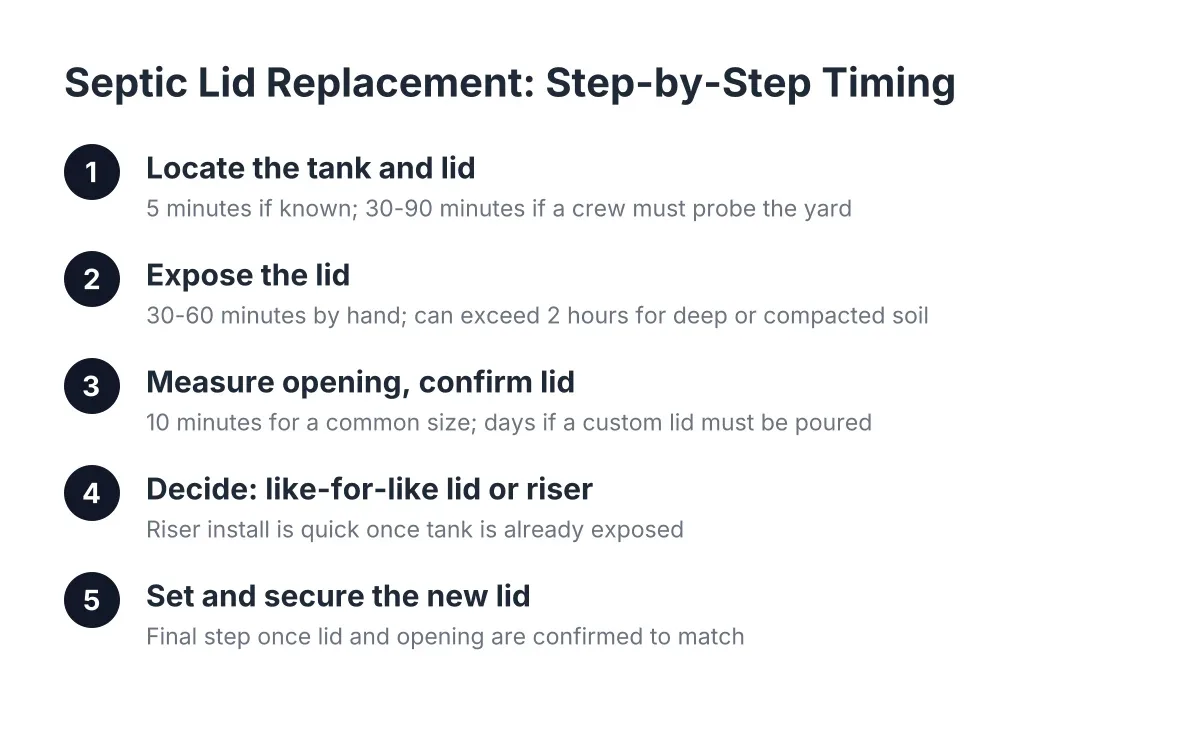
Time impact: if you know where the lid is, this step takes five minutes. If nobody knows, a crew may spend 30 to 90 minutes probing the yard. That is the single biggest variable in how long septic lid replacement runs on the day of service.
Step 2: Expose the Lid
Lids are almost never sitting exposed when a crew pulls up. Plan on digging. A buried lid at 12 to 18 inches takes a two-person crew roughly 30 to 60 minutes to expose by hand in typical Fontana soil. The time for septic lid replacement to reach this stage grows longer with deeper tanks, compacted fill, or roots, which can push exposure past two hours.
You can shrink the appointment by digging the lid out yourself before the crew arrives. Homeowners who expose the lid ahead of time routinely cut an hour or more off the visit. Dig carefully once you hit concrete; a cracked lid can shift under a shovel strike.
One safety rule is non-negotiable. If you expose the lid and the crew is coming later, or if the old lid is broken, cover the opening with a sheet of plywood and a thin layer of dirt. An open or weak lid over a tank is a fall hazard for kids and pets, and a tank holds enough liquid to be deadly.
Time estimate for this step: 30 to 90 minutes, or near zero if you pre-dig.
Step 3: Measure the Opening and Confirm the Replacement Lid
Septic tank openings are not standard. Older concrete tanks in the Fontana area have round or rectangular access openings in a range of sizes, and the lids are usually tapered so they seat into the opening rather than resting flat on top. A replacement lid for a septic tank has to match both the shape and the taper.
A crew measures the opening and checks three things:
- The opening size and shape, so the new lid seats correctly
- The condition of the tank rim, since a crumbling rim needs repair before a new lid will hold
- Whether the tank itself is sound, because replacing just the lid is far cheaper than replacing the tank, and there is no point putting a new lid on a failing tank
For a common size, a service truck may carry a matching concrete or plastic lid, and this step takes 10 minutes. For an odd or older opening, the crew may need to pour a custom concrete lid to fit, which adds a return visit after the concrete cures, typically a few days later. That is the main scenario where the timeline for septic lid replacement stretches to a long one, measured in days instead of hours.
Step 4: Decide Between a Like-for-Like Lid and a Riser
This is the real decision point, and it affects both this appointment and every pump-out after it.
A like-for-like concrete lid restores the tank to its original condition. It is the cheaper option on the day and keeps the lid at its current depth. The trade-off is that every future septic tank pumping or inspection starts with the same digging you just paid for.
A riser with a modern lid extends the tank access up to grade or just below it. Installing a riser on an already-exposed tank is quick; most of the total job time went into the digging, not the assembly. Once it is in, future pump-outs skip excavation entirely. For a landlord with several septic-served units, risers turn a half-day service call into a 45-minute one, every two to three years, which is the pumping interval Penn State Extension recommends for an active family of four.
As of 2026, risers add a few hundred dollars per opening in most cases, as a rough estimate. For an owner-occupied home that pumps every three to five years, a plain lid may be the sensible call. For rentals or a new build where you control placement, the riser usually pays for itself in saved labor.
How Much Time Will Septic Lid Replacement Add to Later Maintenance?
You should not pour a concrete slab, patio, or driveway over a septic tank. The lid must stay accessible for pumping and inspection, and standard residential tank lids are not rated for vehicle traffic. Paving over the access means breaking concrete at the next pump-out, which adds hours and cost to a routine visit.
If you want the area to look clean, use removable cover ideas instead: a fake rock cover, a planter box that lifts off, a gravel bed, or a flush-mounted riser lid with low groundcover around it. All of these hide the lid without burying your future access.
Step 5: Set the New Lid and Secure It
Setting the lid is the fast part. Concrete lids are heavy and tapered, so the crew aligns the lid and lowers it into the seat rather than dropping it. A rushed drop can chip the edge or crack the new lid before it ever carries weight. For plastic riser lids, the crew seats the lid and drives every screw.
Securing matters more than most owners realize. Every screw goes back in, every time, so nobody can dislodge the lid and fall through. On rental properties this is a liability issue, not just a maintenance detail.
Active time for this step: 15 to 30 minutes, including backfill over a buried lid.
How Long Does Septic Lid Replacement Take Start to Finish?
A straightforward septic tank lid replacement, with a known tank location and a stock-size lid on the truck, takes about one to three hours on site. Here is the typical breakdown:
- Locate the tank: 5 to 90 minutes, depending on records
- Expose the lid: 30 to 90 minutes, or near zero if pre-dug
- Measure and match the lid: 10 to 30 minutes
- Set and secure the new lid: 15 to 30 minutes
- Backfill and cleanup: 15 to 30 minutes
Custom-poured concrete lids add curing time and a second visit, so plan on two to five days total for odd-size openings. On new construction, the schedule can also hinge on county inspection timing, which no contractor controls; build slack into your timeline rather than assuming same-week signoff.
Is the Septic System Down During the Work?
No. This surprises people, but your septic system keeps working during a lid replacement. The lid covers the access opening; it does not control flow. Wastewater still enters the tank, separates, and sends liquid out to the drain field the whole time, consistent with how the U.S. Environmental Protection Agency describes a conventional system: a tank that clarifies wastewater and a drain field that disperses it.
Therefore, tenants can shower, flush, and run laundry while the crew works. There is no need to schedule around vacancy or issue a water-use notice. The only exception is when the lid work is combined with a pump-out or a repair inside the tank; even then, normal household use usually resumes the same day.
Suppose a landlord with a duplex in the Fontana area gets a code enforcement notice about a sunken, cracked lid. In that scenario, a typical sequence looks like this: crew arrives in the morning, exposes both lids in about an hour, finds standard openings, sets two new lids, and backfills by early afternoon. Tenants never lose service, and the notice gets cleared with photos the same day.
What Can Stretch the Timeline, and When to Call a Pro
A few situations turn a short job into a long septic lid replacement timeline, and some of them call for a professional rather than a DIY fix:
- A collapsed or badly cracked lid, which may mean the tank rim or the tank itself is compromised
- A tank you cannot locate at all, where a crew with locating experience saves hours of blind digging
- Signs of a bigger problem, such as a backup, a slow drain throughout the house, or soggy ground over the drain field
- A lid under a later-added patio, deck, or paving
One honest limitation: a new lid fixes access and safety, not system health. If the lid cracked because the tank is overdue for service or the drain field is failing, the lid is the cheap part. EPA guidance puts routine maintenance at $250 to $500 every three to five years, versus $5,000 to $15,000 to repair or replace a failed conventional system, according to the U.S. Environmental Protection Agency. A septic system inspection during the lid job costs little extra time and tells you which side of that math you are on.
If you need septic tank pumping, Fontana Septic can help.
Prefer to talk it through? Call (909) 316-2368 — a quick call is usually the fastest way to get a straight answer for your situation.