
Concrete vs. Plastic Septic Tank Lids: Durability, Cost, and How to Replace One
A cracked septic tank lid is one of those problems that looks small until it isn't. The lid is the only thing standing between your yard and an open tank of sewage, and when it cracks, sinks, or crumbles at the edge, you have both a safety hazard and a maintenance headache. Before you buy a replacement, you have one real decision to make: concrete or plastic. The two materials behave differently in the ground, cost different amounts, and fail in different ways. This guide walks through the choice step by step, the way a local septic crew in Fontana would explain it over the phone.
One note before we start. Replacing a lid is a reasonable homeowner project when the tank is sound and the opening is standard. If the lid collapsed inward, if the tank walls look damaged, or if you are building new and the county will inspect the work, bring in a septic system inspector before you touch anything.
Step 1: Confirm the Problem Is the Lid, Not the Tank
First, figure out what you are actually replacing. A broken lid on a sound tank is a cheap fix. A lid that broke because the tank itself is failing is a different job entirely.
Look at the opening once the lid is exposed. The rim should be solid, square or round depending on the tank, and free of large cracks running down into the tank wall. Tank shapes vary by region; some areas use rectangular concrete tanks and others use circular ones, according to the International Code Council. In the Fontana area, you will see both.
This matters for your wallet. According to U.S. Environmental Protection Agency guidance, repairing or replacing a failed conventional system runs $5,000 to $15,000, while routine maintenance costs $250 to $500 every three to five years. A lid is a small fraction of that. Confirming the tank is sound keeps you in the small-fix column.
Where Is the Lid to My Septic Tank?
The septic tank lid sits over the tank's access openings, usually buried a few inches to a couple of feet below the lawn between the house and the drain field. Most residential tanks have one or two lids, one over the inlet side and one over the outlet. If you have a riser installed, the lid sits at or near grade and you can see it.
If nothing is visible, trace the main sewer line out from the house. The tank usually sits 10 to 25 feet from the foundation. A septic pumper who has serviced the property before can locate it fast, and county records from a past permit often show a site diagram.
Step 2: Compare Concrete and Plastic Septic Tank Lids Honestly
Next, weigh the two materials against your actual situation. Neither one wins every category, so here is the honest breakdown.
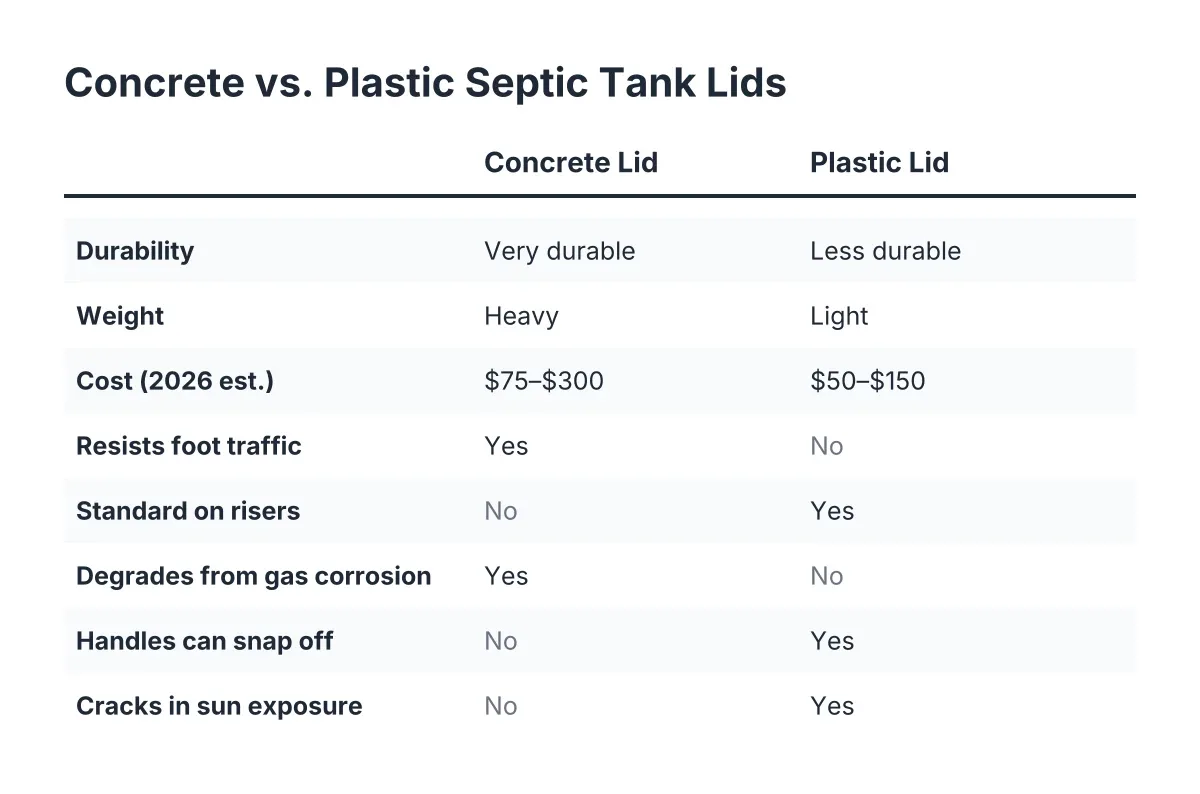
Concrete lids:
- Heavy enough that kids, dogs, and casual foot traffic cannot shift them.
- Match the tank most older Fontana-area homes already have, which is concrete.
- Many lids are not solid slab; they use a lighter core covered in concrete so a crew can lift them for a pump-out without machinery.
- Degrade slowly from the inside, because tank gases corrode the underside over years. By the time a concrete lid looks bad on top, it may be brittle underneath.
- Cost more to ship and handle, and a cracked one must be replaced, not patched.
Plastic lids:
- Light, cheap, and easy for one person to handle.
- Standard on risers, which bring the access point up to grade so future pump-outs do not require digging.
- Have handles that snap off when pulled, especially after a few years of sun and soil pressure. When that happens, crews often break the old lid out and install a riser with a new lid.
- Can crack or crush under vehicle weight or a misplaced wheelbarrow. Never drive over either material, but plastic forgives less.
As a general rule, concrete is the durability pick and plastic is the convenience pick. Installers tend to favor concrete tanks and lids for longevity; plastic earns its place when you are adding a riser or working a tight budget. Illustrative 2026 pricing: a plastic riser lid often runs $50 to $150 for the part, while a replacement concrete lid typically runs $75 to $300 depending on size, with delivery or a poured-to-fit lid adding more. Those are estimates, not quotes; your opening's dimensions drive the real number.
Will a Septic Tank Freeze With a Riser?
A septic tank with a riser rarely freezes in the Fontana area, because inland Southern California winters do not produce sustained hard freezes. In cold climates, an uninsulated riser can let frost reach the tank, which is why northern installers add insulated lids. Locally, freezing is not the concern; sun exposure cracking plastic lids over time is the more realistic issue here.
Step 3: Measure the Opening Before You Buy Anything
Measure twice, buy once. Septic tank lids are not one size. Expose the full rim of the opening and record three numbers: the shape, the width across the opening, and the lip or seat depth where the lid rests.
Round openings are common on newer tanks, and round lids sealed by tank gas can become brittle and break when pried. Older tapered concrete lids seat differently than flat round ones. If your opening is an odd size, a standard lid from a supply yard will not fit; a concrete lid can be poured to match the existing opening, which is far cheaper than touching the tank itself.
In addition, think ahead to the next pump-out. San Bernardino County's minimum capacity table requires a 1,000-gallon tank for a 3-bedroom home and 1,500 gallons for a 5-6 bedroom home, according to the San Bernardino County Department of Public Health. Bigger tanks mean bigger access needs. If your lid is buried deep, this is the moment to add a riser and extension so the next crew is not digging for an hour before the hose comes out.
Step 4: Remove the Damaged Lid Safely
Treat the open tank like the hazard it is. The gases inside displace oxygen and can knock an adult unconscious, and a fall into a tank is often fatal. Never lean over the opening, never let anyone work alone, and keep kids and pets inside until the new lid is seated.
Pry a concrete lid from the edge with a bar, lifting one side first rather than pulling straight up. If it crumbles as you lift, stop; brittle lids shed chunks into the tank. For a plastic lid with a snapped handle, work a flat bar around the seat gently. Set the old lid well away from the hole and never leave the opening uncovered, even for a quick trip to the truck or garage. Lay plywood over it if you step away.
This is also the step where a lot of homeowners decide the job belongs to a pro. A septic system services crew handles open tanks weekly and carries lids and risers on the truck, so the hole is never open longer than it has to be.
Step 5: Set the New Lid and Seal the Opening
Now seat the replacement. A concrete lid should rest flat on its lip with no rocking; shim nothing, because a rocking lid cracks under its own weight. A riser lid screws or bolts down per the manufacturer's pattern, and every fastener matters, since a loose riser lid is how children and animals get in.
Before backfilling a buried concrete lid, lay plastic sheeting over it. The sheeting keeps dirt and debris from sifting through seams into the tank and makes the lid easier to find clean at the next pump-out. Backfill in layers and compact lightly as you go so the soil over the lid does not sink into a telltale depression.
One hard rule: do not pour a concrete patio, slab, or driveway over the tank or its lids. Can you put concrete over a septic tank? No. You would block access for pumping and inspection, add load the tank was not designed for, and in a new construction scenario, fail your county inspection. Keep the area over the tank in lawn, gravel, or removable cover.
Step 6: Dress the Lid So It Is Safe and Not Ugly
Finally, deal with the part nobody tells you about: a riser lid at grade is a green or black plastic disc in the middle of your yard. You have cover options, with one firm limit. Nothing heavy, permanent, or rooted goes on top.
Workable septic tank lid cover ideas include:
- A lightweight faux rock cover made for utility lids, which lifts off in seconds.
- A planter or potted arrangement set beside, not on, the lid.
- Decorative gravel in a shallow ring around a flush-mounted lid.
- A removable birdbath or garden ornament light enough for one person to move.
Avoid raised beds, shrubs with real root systems, pavers mortared in place, and anything a pump-out crew cannot move in under a minute. The whole point of the lid, and of septic tank lid replacement generally, is fast access. A cover that defeats access just recreates the buried-lid problem you fixed in Step 3.
When to Hand the Job to a Local Crew
Suppose a homeowner in north Fontana finds a crumbling concrete lid two days before a scheduled pump-out. In that scenario, the smart move is letting the crew handle both in one visit: they confirm the opening size, swap or pour the lid, and the tank is open only while the truck is on site. One trip, one hole, one afternoon.
Call a professional instead of doing it yourself when the lid has collapsed into the tank, the opening rim is cracked, the lid is an odd size, or a sale or county inspection is coming. New construction owners in particular should let the installing contractor or a septic tank inspector handle lids, because the county will look at access points during final inspection. A sound, correctly seated lid, concrete or plastic, is cheap insurance on the most expensive hole in your yard.
If you need septic tank pumping, Fontana Septic can help.
Prefer to talk it through? Call (909) 316-2368 — a quick call is usually the fastest way to get a straight answer for your situation.