
What Affects Septic Pumping Price: Tank Size, Frequency, and Location
If you just bought your first home on a septic system, you want a straight answer on what a pump-out should cost and why quotes vary. This guide walks through everything that affects septic pumping price factors: tank size, how often you pump, how easy the tank is to reach, and where you live. By the end, you should be able to read a quote from any septic pumper in the Fontana area and know whether the number makes sense.
No two properties pay exactly the same price, and that is not a scam. It is the result of a handful of physical factors you can check yourself before you ever pick up the phone. Let's go through them one at a time.
First, What a Pump-Out Actually Pays For
Before the price factors make sense, it helps to know what you are buying. A typical residential septic system has two main parts: a tank that holds and settles wastewater, and a drain field that spreads the clarified liquid into the soil, according to US EPA. A single pipe carries everything from your household drains to the tank. Solids sink and stay. Liquid flows out to the leach field.
Those solids are the reason you pump. They build up over time, and the only way to remove them is a truck with a vacuum hose. According to the New Hampshire Department of Environmental Services, waste pumped from residential tanks is hauled by truck to a sewage treatment plant for disposal, not processed on site.
So a pump-out price covers real, unavoidable costs:
- Truck time and fuel to reach your property
- Labor to locate and open the tank, pump it, and check basic components
- Disposal fees the pumper pays at the treatment plant
- Overhead like insurance and equipment maintenance
Disposal fees matter more than most first-time owners realize. The pumper pays by volume to dump the load, which is one reason tank size drives price so directly.
Tank Size Is the Biggest Single Factor That Affects Septic Pumping Price
A bigger tank holds more waste, takes longer to pump, and costs more to dispose of. That is the whole equation. In San Bernardino County, the minimum tank size is tied to bedroom count: a 3-bedroom home requires at least a 1,000-gallon tank, and a 5-to-6-bedroom home requires 1,500 gallons, according to the San Bernardino County Department of Public Health.
That means if you bought a 3-bedroom house in Fontana, you are most likely looking at a 1,000-gallon tank, and your pump-out will usually land in the lower part of the local price range. A larger home on a 1,500-gallon tank pays more per visit because there is simply more volume to haul away and pay disposal on.
Here is where new owners get tripped up. You often do not know your tank size when you call. That is fine, and an honest septic pumper will say so. But it also explains why some companies quote a base price "up to X gallons" with a per-gallon charge beyond that. Read the fine print on any quote: a low headline price that only covers 750 gallons will grow once the crew measures your actual tank.
If your home inspection report or county permit records list the tank size, keep that paper handy. It lets you compare quotes on equal footing instead of guessing.
How Pumping Frequency and Other Factors Affect Septic Pumping Price Over Time
The per-visit price is only half the picture. What you actually care about is cost per year of ownership, and frequency controls that number. Understanding the septic pumping price factors that influence your total expense—including tank capacity, how often service is needed, and property accessibility—helps you budget accurately over the life of your system.
How often do septic systems need to be pumped out?
Most septic tanks need pumping every three to five years, though household size and tank size shift that window in both directions. According to Penn State Extension, an active family of four generally does well pumping every two to three years because they produce more solids and wastewater. A retired couple on the same tank might stretch to five years.
Two things drive frequency more than anything else: how heavily the system is used and how big the tank is. Elapsed time matters less than people think. A 1,000-gallon tank serving two adults fills with solids slowly. The same tank serving a family of six with teenagers fills fast.
There is a real trade-off here, and it runs in both directions. Pump too rarely and solids climb high enough to flow into the leach field, which is how a maintenance bill turns into a repair bill. Pump too often and you are paying for truck visits your tank did not need. Neither extreme saves money.
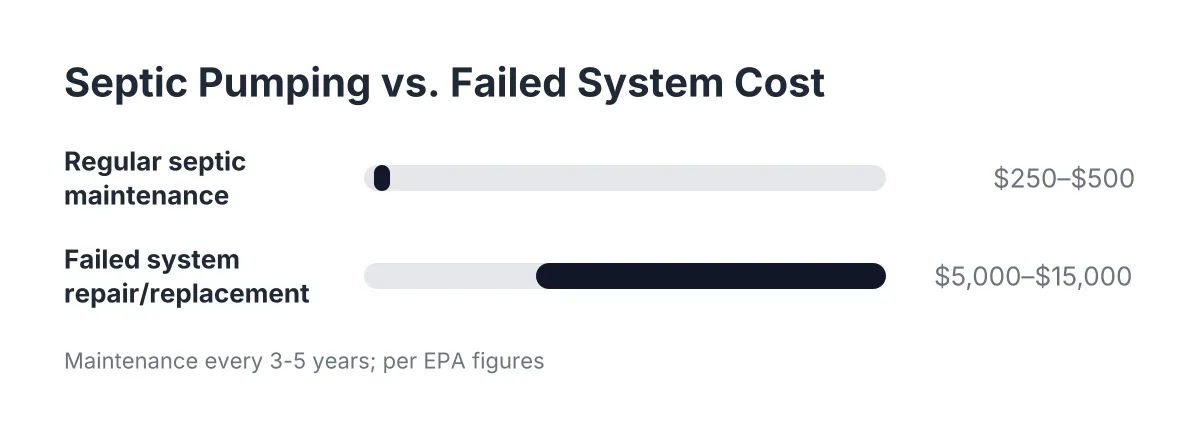
The financial stakes are lopsided, though. According to the U.S. Environmental Protection Agency, regular septic maintenance runs about $250 to $500 every three to five years, while repairing or replacing a failed conventional system runs $5,000 to $15,000. On those numbers, over-pumping wastes a couple hundred dollars; under-pumping risks a five-figure hit.
A first-year budget example
Suppose you just closed on a 3-bedroom home in north Fontana with a 1,000-gallon tank, and the seller's disclosure says the tank has not been pumped in six years. In that scenario, a sensible first year looks like this:
- Schedule a pump-out now, since six years is past the safe window for a tank of unknown condition.
- Have the crew note sludge depth, baffle condition, and any signs of backup while the lid is open.
- Based on what they find and your household size, set your next pump-out for two to four years out.
That first visit is the most important dollar you spend as a new septic owner. It resets the clock and gives you a baseline on the tank's condition.
Location and Access: The Factors You Can See From Your Driveway
Once tank size and frequency are set, the rest of what affects the cost of septic pumping is about your specific property. These are the factors that make two neighbors with identical tanks pay different amounts.
Where the tank sits on your lot
Pump trucks carry heavy hoses, and hose length is limited. If the truck can park within a normal hose run of your tank lids, you pay the standard rate. If your tank sits far behind the house, downhill from the only parking spot, or behind a locked side yard, the job takes longer and some companies charge for it. On rural parcels around Fontana, in areas like Sunnyslope or the unincorporated county pockets, long driveways and deep lots are common, so ask about hose distance when you call.
Whether the lids are buried
Many older Fontana-area tanks have lids buried under a foot or more of soil. Digging to expose them is labor, and most pumpers bill it as such. If the previous owner installed risers, lids that sit at or near ground level, you skip that charge every single visit. Risers cost money up front but pay for themselves over a few pump-outs. If you do not know where your lids are, county permit records or your home inspection sketch often show the tank location.
Regional supply and demand
Pump-out pricing also reflects how many trucks operate in your area relative to how many homes need them. California is a low-septic state overall; EPA data shows about 10% of California homes use septic systems, compared to 55% in Vermont. Fewer septic homes can mean fewer local pumpers competing, which shapes prices differently than in heavy-septic regions. This is also why price guides written for Texas or Ohio do not translate cleanly to San Bernardino County; disposal fees, drive distances, and competition all differ.
Timing and emergencies
A scheduled pump-out on a weekday costs less than an emergency call on a Saturday night with sewage backing up into the shower. Emergency septic and drain service exists for a reason, but it is priced for a reason too. The cheapest pump-out you will ever buy is the one you schedule before there is a problem.
Why Septic Service Quotes Vary So Much
Take three quotes for the same address and you may see numbers that differ by 50% or more. Here is what usually explains the spread.
First, the quotes may not cover the same work. One company's price includes digging up buried lids; another charges separately. One includes pumping both compartments of a two-compartment tank; another quotes only the first. Ask each company to itemize.
Second, pumping is a competitive, thin-margin service, and some operators price it low to get on your property, then make their money on add-ons. That is not automatically dishonest; some add-ons are legitimate. But it is why a suspiciously low quote deserves the question: what exactly is included, and what commonly gets added at the truck?
Third, watch for upsells you can evaluate yourself. Additives and monthly "treatments" are a common one; a properly used tank does not need them. Filter cleaning, riser installation, and baffle repair, on the other hand, are real services with real value. The difference between a fair operator and a fly-by-night one is usually whether they can explain, in plain terms, why your specific tank needs the extra item.
One practical decision rule saves money here. A septic system inspection often costs close to what a pump-out costs, because both require locating and opening the tank. Therefore, if your tank is due anyway, having it pumped and evaluated in the same visit usually beats paying separately for an inspection-only diagnosis. The exception is a real estate transaction, where a formal septic system inspection with documentation is its own product and worth paying for on its own.
How Much Does Septic System Maintenance Cost?
Routine septic maintenance costs about $250 to $500 every three to five years for a conventional system, according to the U.S. Environmental Protection Agency; that figure covers periodic pumping, the core of septic care. Your actual number depends on tank size, access, and how often your household load requires pumping.
Beyond pumping, budget a small amount for occasional extras: an effluent filter cleaning, a riser installation once so future visits are cheaper, or a leach field inspection if drains run slow. None of these are every-year expenses on a healthy system.
You can also lower your long-run septic system costs through habits, not just service intervals. Fix running toilets fast; according to the U.S. Environmental Protection Agency, a single leaky or running toilet can waste up to 200 gallons of water per day, all of it flowing into your tank and drain field. Keep grease out of the sink as well. Research published in the International Journal of Environmental Science and Technology estimates 30-40% of sewer clogs come from fat, oil, and grease deposits, and the same material hardens inside septic tanks and lines.
What Happens If You Skip Pumping to Save Money
Skipping pump-outs to save money usually backfires, because solids that overfill the tank flow into the drain field and clog the soil. Once a leach field fails, no amount of pumping fixes it. At that point you are into repair or replacement, the $5,000 to $15,000 range the EPA cites for a failed conventional system.
Watch for the early warning signs: slow drains throughout the house, gurgling pipes, sewage odors in the yard, or unusually green, soggy grass over the drain field. Any of these means call a septic pumper or septic tank inspector now, not next quarter. A backup into the home is the late-stage version of the same problem, and it adds cleanup costs on top of the septic work.
One honest limitation: a pump-out fixes solids buildup, but it cannot diagnose everything. If your drains stay slow after a fresh pumping, the problem is likely in the line, the baffles, or the leach field, and that calls for a professional inspection rather than another pump-out.
A Note for Builders and Developers on New Systems
Pumping economics and installation economics are different animals. If you are a builder working unsewered parcels in the Fontana area, your cost drivers are soil conditions, percolation results, trench depth, rock, and whether the site needs a pump system instead of gravity flow. Adding a pump chamber alone moves a project's budget meaningfully compared to a straight gravity-fed install.
An installed system's price breaks into distinct buckets: the tank, the permit, drain field materials like chambers and pipe and risers, equipment time, and fuel. County health department design approval comes before construction, so build that review into your permit timeline. Installation also demands licensed expertise beyond what a pumping operation carries; according to the New Hampshire Department of Environmental Services, licensed installers must pass exams covering soil types, percolation rates, system design, and local regulations. Setbacks matter too; most local rules require at least 10 feet between the septic system and the building it serves, per the Minnesota Pollution Control Agency.
The Short Version: How to Judge Any Pump-Out Quote
When a quote lands in front of you, run it against this checklist:
- Does the price state a gallon capacity, and does it match your tank size?
- Are buried-lid digging, second compartments, and filter cleaning included or extra?
- Is disposal included, or billed separately?
- Is there an access or distance charge for your lot?
- Is it a scheduled visit or emergency pricing?
Answer those five questions and you have accounted for nearly everything that affects septic pumping price at a normal Fontana home. As of 2026, the pattern holds: size sets the base, frequency sets your annual cost, and access plus timing set the adjustments. A local operator who answers those questions plainly over the phone, without routing you through a dispatch center, is telling you something about how the rest of the job will go too.
If you need septic tank pumping, Fontana Septic can help.
Prefer to talk it through? Call (909) 316-2368 — a quick call is usually the fastest way to get a straight answer for your situation.