
Septic System Costs — Complete Guide
Buying your first rural property means learning fast, and nothing catches new owners off guard like septic system cost. Unlike a city sewer bill, septic expenses arrive in lumps: a pump-out here, an inspection there, and occasionally a repair bill that lands in the thousands. This guide pulls together real pricing for pumping, inspection, repair, and replacement so you can budget accurately and spot an inflated quote before you sign anything. You will also find links to detailed cost breakdowns for each service, plus answers to the questions Fontana homeowners ask us most often.
What You'll Find in This Guide
- What Affects Septic Pumping Price: Tank Size, Frequency, and Location
- Emergency Septic Service Cost in Fontana: Same-Day Rates, What Drives Them, and How to Pay Less
- Septic System Costs Terms Explained: A Plain-English Glossary
Understanding Septic System Costs for Routine Service
Most of what you spend on a septic system goes to routine work: pumping every few years, inspections, and maintenance. This category is predictable once you understand the variables.
Tank size affects costs significantly. A bigger tank holds more waste and takes longer to pump. San Bernardino County requires a 1,000-gallon tank for a 3-bedroom home and 1,500 gallons for a 5–6 bedroom home, per the San Bernardino County Department of Public Health. Neighbors on the same street can get different quotes because their homes have different bedroom counts.
Access matters more than most first-time owners expect. If tank lids sit under two feet of soil, crews must dig before pumping, adding labor costs. A tank far from the driveway may require extra hose and setup fees. Frequency also plays a role—a tank pumped on schedule takes less time to clean than one neglected for years, since compacted sludge is slow work.
For a full breakdown of these variables and typical pump-out costs, read our guide on what affects septic pumping price. It's written specifically for owners who just closed on their first septic property.
Inspections follow similar logic. A basic visual inspection costs less than a full evaluation with tank locating, flow testing, and a written report. The more thorough option often pays for itself—an inspection catching a failing baffle early can save you the cost of a leach field repair later. Treat inspection pricing as a range tied to depth of service, not a flat number.
Repair and Replacement: Where Septic System Costs Get Serious
Routine service is measured in hundreds of dollars. Repairs and replacements are measured in thousands, and this is where a realistic budget protects you most.
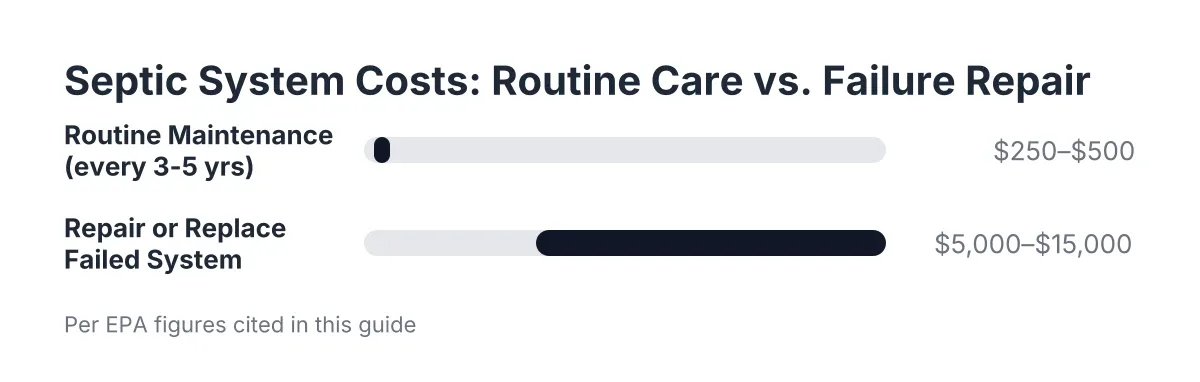
The gap between maintenance and failure is dramatic. According to the U.S. Environmental Protection Agency, regular septic maintenance costs $250 to $500 every three to five years, while repairing or replacing a failed conventional system runs $5,000 to $15,000. To put it simply, every dollar you spend on scheduled pumping works to keep five-figure repair bills off your calendar.
What Repair Quotes Actually Cover
Repair pricing varies because the word "repair" covers everything from a cracked lid to a collapsed tank. On the low end, replacing a baffle or a riser is a quick job with modest parts costs. In the middle, you find pump replacements, broken line repairs, and distribution box work. At the top sits leach field repair or replacement, which involves excavation, new materials, permits, and inspections. Because the components differ so much, insist on itemized quotes that name the specific part being fixed.
Timing also changes the math. A slow drain noticed on a Tuesday costs less to address than sewage backing up on a Saturday night. That said, emergencies do happen, and knowing the rate structure ahead of time keeps you from panicking when they do. Our guide to emergency septic service cost in Fontana covers same-day rates and how to pay less when the clock is against you.
Small Problems That Inflate Big Bills
Household habits feed directly into repair risk. For instance, a single leaky or running toilet can waste as much as 200 gallons of water per day, according to the U.S. Environmental Protection Agency. That extra water floods the tank, pushes solids into the leach field, and shortens the field's life. Fixing a $20 flapper valve is one of the cheapest septic repairs you will ever make. The EPA's SepticSmart program offers more homeowner guidance on habits that protect your system.
How to Compare Septic Quotes Without Getting Overcharged
Once you know the ranges, the next skill is reading quotes critically. First-time rural buyers are a favorite target for vague pricing, because you have no billing history to compare against. However, a few habits level the playing field quickly.
Start by demanding itemization. A legitimate quote separates the pump-out fee, disposal fees, digging or access charges, and any add-on services. In contrast, a single lump-sum number hides where the money goes and makes comparison impossible. If a company resists itemizing, treat that as useful information about how they do business.
Next, learn the vocabulary before you talk to anyone. Terms like scum layer, effluent filter, baffle, and leach line show up constantly on quotes and inspection reports. Additionally, some companies use jargon to justify upsells that a routine pump-out never needed. Our plain-English glossary of septic system cost terms decodes the language so you can ask sharp questions instead of nodding along.
Why Two Quotes for the Same Job Differ
Quote differences usually trace back to a few legitimate factors: tank size assumptions, access difficulty, disposal costs, and how thoroughly the company cleans the tank. For example, one company may quote a "pump-out" that removes liquid only, while another quotes full removal of sludge and scum with a rinse. The second quote costs more and delivers more. Therefore, always confirm exactly what the service includes before comparing numbers side by side.
Watch for scope creep too. A pumping visit that suddenly "requires" additives, unnecessary treatments, or an unprompted camera inspection deserves scrutiny. That said, some add-ons are genuinely worth it, like an effluent filter cleaning while the tank is already open. The difference is whether the technician explains the reason and shows you the problem, or simply adds a line to the bill.
Finally, favor local operators who answer their own phone. National directories and franchise dispatch centers add a markup layer between you and the truck. Meanwhile, a Fontana crew that works septic every day knows county requirements, local soil conditions, and what a fair price looks like on your street.
Frequently Asked Questions
How much does a septic system cost in Fontana, CA?
Routine service like pumping and inspection typically costs hundreds of dollars per visit. A failed system is costlier: EPA guidance puts repair or replacement at $5,000 to $15,000. Your exact cost depends on tank size, site access, and prior maintenance.
What is a septic system and how does it work?
A septic system is your property's private wastewater treatment setup. Wastewater flows from the house into a buried tank, where solids settle and break down. The liquid then moves to a leach field, where soil filters it naturally. Everything works by gravity and biology, which is why overloading the system with water or grease causes trouble.
How much does septic system maintenance cost?
According to the EPA, regular maintenance costs $250 to $500 every three to five years for routine pumping and inspection. Compared to five-figure failure repairs, scheduled maintenance is the cheapest line item in septic ownership.
How often do septic systems need to be pumped out?
Most households need pumping every three to five years. Your actual interval depends on tank size, household size, and water habits. A large family with a 1,000-gallon tank fills faster than a couple with a 1,500-gallon tank. An inspection reveals where your tank stands now.
What are the signs that a septic system is failing?
Watch for slow drains, gurgling pipes, sewage odors indoors or in the yard, and soggy or unusually green grass over the leach field. Sewage backing up into tubs or floor drains is the most urgent sign. If you notice any of these, stop running water and call for service immediately.
Can I install a septic system myself or do I need a professional in Fontana?
You need a professional. San Bernardino County regulates septic installation, including minimum tank capacities tied to bedroom count, and the work requires permits, engineered plans, and inspections. A botched installation fails early and costs far more to redo than a proper install costs initially.
Ready to Get Started?
If you want a straight answer on what your tank, your property, and your situation should actually cost, talk to a local crew that does septic work all day and nothing else. We give Fontana homeowners itemized pricing upfront, so you know what you are paying for before a truck ever rolls out. Call us and get a real number from a real person, not a dispatch center.