
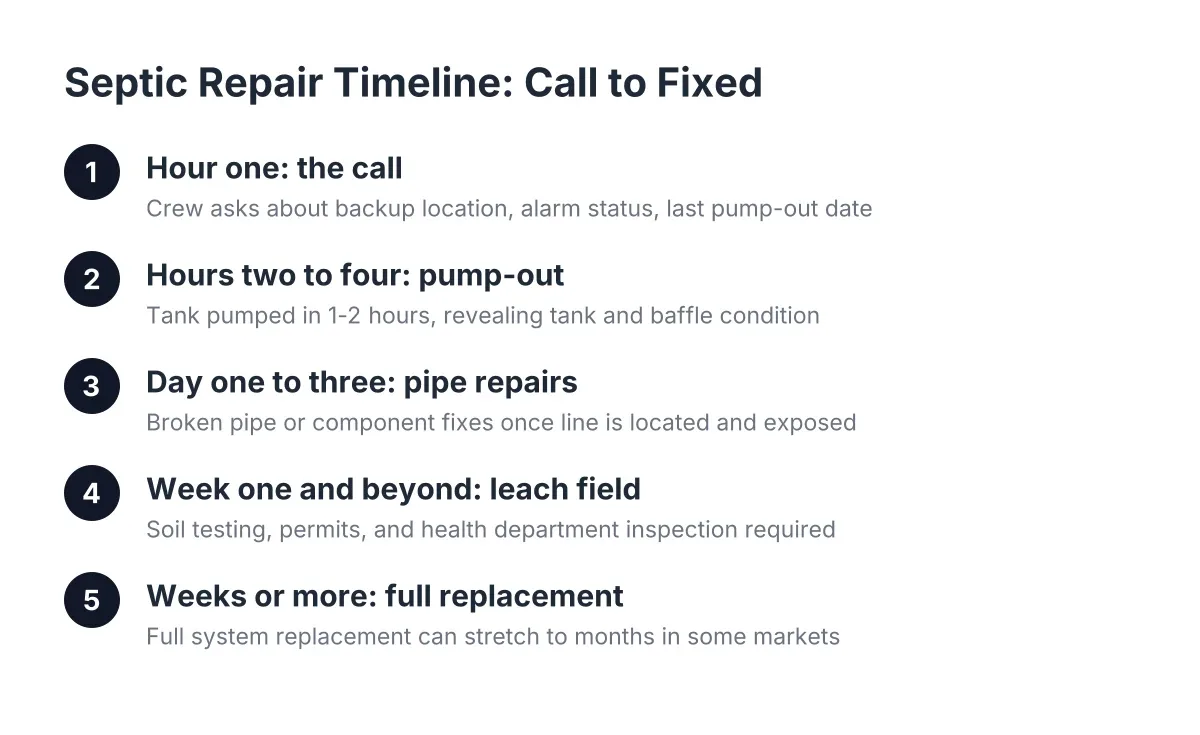
How Long Emergency Septic Repairs Take: Timeline From Call to Fixed System
When sewage backs up into a rental unit, the first question a landlord asks is not what happened. It is how long this will take to fix. Short answer: most septic emergencies get stabilized the same day with a pump-out, while long emergency repairs, like leach field replacement, can stretch to weeks once permits and inspections enter the picture. This guide walks through the full septic repair timeline, from the first phone call to a working system, so you can plan tenant communication, budget, and downtime instead of guessing.
This matters more when you manage several properties on septic. One backed-up duplex is not just a maintenance ticket. It is a habitability issue with a clock on it. Knowing which repairs take hours and which take weeks tells you when to relocate a tenant, when to schedule a vacate-and-repair around lease turnover, and when a fast pump-out buys you the time to do the job right.
The Short Version: Emergency Septic Repair Timelines at a Glance
Here is the realistic range, from fastest to slowest. These are illustrative timelines, not promises, and your situation can move faster or slower depending on access, weather, and county scheduling.
- Emergency pump-out to stop a backup: usually same day or next day, and the pumping itself takes about one to two hours on site.
- Drain line or inlet baffle clog cleared: same visit as the pump-out in many cases, a few hours total.
- Broken pipe between house and tank: one to three days once the line is located and exposed.
- Pump or float switch replacement on a pump system: one to a few days, depending on parts.
- Leach field repair or partial replacement: days to weeks, because soil testing, permits, and health department inspection get involved.
- Full system replacement: weeks at minimum, and during supply or labor disruptions, installation waits have stretched to several months in some markets.
The pattern is simple. Anything a septic pumper can fix with a truck and hand tools resolves fast. Anything that touches the soil, the drain field, or a permit takes longer, and no honest company will promise otherwise.
Hour One: The Call and What a Local Crew Asks First
The first call sets the pace for everything after it. A local Fontana septic crew will ask a handful of questions to decide whether you need an emergency pump-out today or a scheduled repair this week. Where is the sewage showing up, in the lowest drain, the yard, or both? Is a septic alarm sounding? When was the tank last pumped? How many units share the system?
Your answers matter here. If you can tell the crew the tank location, the last pump-out date, and whether the lid is accessible, you shave time off the visit before the truck leaves the yard. Landlords who keep a one-page septic record per property, tank location, size, and service dates, consistently get faster resolutions than owners who have to call the previous owner to ask where the tank is.
One decision rule worth knowing: for a backup on a septic property, call a septic service first, not a general plumber. A septic company can diagnose whether the problem sits in the tank, the line, or the drain field. A plumber only helps if the blockage turns out to be inside the building's own plumbing. Calling the wrong trade first is the most common way owners add a full day to the timeline. If you do call a plumber for an interior clog, tell them upfront the property is on septic, because that changes how they should diagnose and snake the line.
What you can do while you wait
First, stop water use in the affected unit. Tell tenants to hold off on laundry, dishwashers, and showers, since every gallon in makes the backup worse. Next, keep people and pets away from any pooling sewage in the yard. If the system has a pump and the alarm is sounding, shutting down water use alone often keeps the tank from overflowing until the crew arrives. Do not open the tank lid yourself; the gases inside are dangerous, and a fall into a tank can be fatal.
Hours Two Through Four: Diagnosis and the Emergency Pump-Out
Most emergency visits start the same way, with a pump-out. Emptying the tank does two things at once. It relieves the immediate pressure so sewage stops backing into the building, and it lets the septic tank inspector see the tank's condition, the baffles, the inlet and outlet, and the liquid levels that tell the story of what failed.
The pumping itself takes about one to two hours for a typical residential tank. In San Bernardino County, minimum tank sizes run from 1,000 gallons for a three-bedroom home up to 1,500 gallons for a five- or six-bedroom home, according to San Bernardino County Department of Public Health. A shared tank serving a duplex or a small multi-unit property sits at the larger end, so plan for the longer side of that window. The pumped waste is hauled by truck to a treatment plant for disposal, according to New Hampshire Department of Environmental Services, so there is no mess left on site when the job is done right.
Here is the honest part. A large share of emergency backup calls trace back to one cause: the tank went years past its pump-out interval, and sludge built up until solids pushed into the outlet or the drain field. In those cases, the pump-out itself is the repair. The system works again the same afternoon, and the fix going forward is a schedule, not a construction project. For an active household of four, pumping every two to three years is the general guideline, according to Penn State Extension. Rentals with heavy occupancy or garbage disposals often need the shorter end of that range.
When Long Septic Repair Timelines Enter the Picture
Sometimes the pump-out reveals a bigger problem, and that is when long emergency septic repairs begin. The dividing line is usually the drain field. A typical residential septic system has two main components, a tank that settles and clarifies wastewater and a drain field that disperses the liquid into the soil, according to US EPA. Tank-side problems resolve in hours or days. Drain field problems resolve in days to weeks, because you are now working with soil, groundwater, and the county.
Day one to day three: pipe and component repairs
Suppose the crew pumps the tank and the level rises again within hours even with the water off. That points to groundwater intrusion or a failed line, not a full tank. A broken or root-invaded pipe between the house and the tank typically takes one to three days to fix: locate the line, dig, replace the section, and backfill. On systems with a pump, a failed pump or stuck float switch is a parts-and-labor job that runs a day or a few days depending on availability. Crews treat a high water alarm as urgent for a reason; catching it early usually keeps the repair on the short end of the septic repair timeline and keeps sewage out of the building entirely.
Week one and beyond: leach field repair
A saturated or failed leach field is the slow lane. The soil has to be evaluated, sometimes with a percolation test, which measures how well the ground absorbs water and must be done before installing or replacing a system, according to University of Nebraska-Lincoln Extension. After that, the local health department typically inspects as part of the process, according to Caroline County Health Department. Permit review and inspection scheduling sit outside any contractor's control, and those steps, not the digging, are what stretch the calendar.
During the wait, the system still has to function. The standard bridge is scheduled pumping, running the property on repeated pump-outs so tenants can stay in place while the repair moves through permitting. It is not cheap, but it is far cheaper than a vacancy or a habitability complaint. For context on the stakes, the U.S. Environmental Protection Agency puts routine maintenance at $250 to $500 every three to five years, versus $5,000 to $15,000 to repair or replace a failed conventional system. That gap is the whole argument for a pump-out schedule across your portfolio.
An Illustrative Timeline: A Duplex Backup in Fontana
Say a landlord with a duplex on the north side of Fontana gets a tenant call on a Tuesday morning: sewage in the downstairs tub, smell in the yard. Here is how that scenario typically plays out.
- Tuesday, 8 a.m.: The landlord calls a local septic company, gives the tank location and last pump date (four years ago, overdue), and tells tenants in both units to stop running water.
- Tuesday, midday: The truck arrives, locates and opens the tank, and pumps it. The backup in the tub drains. The inspector notes the outlet baffle is intact and the drain field accepts water. Diagnosis: overdue pump-out, heavy solids. Time on site, about two hours.
- Tuesday, afternoon: The crew clears a partial clog in the inlet line while there. The system is fully working by dinner. The landlord gets the tank size, condition notes, and a recommended pump-out interval in writing for the property file.
- Following week: The landlord puts both of his septic-served properties on a recurring pump-out schedule so the next tenant call never happens.
In that scenario, total downtime was under a day. Now change one detail: the drain field is saturated and water stands over the lateral lines. The same Tuesday call becomes a two-to-four-week project, with interim pump-outs every week or two to keep the units livable while a leach field repair moves through county review. Same phone call, wildly different timeline, and the difference was decided years earlier by whether the tank got pumped on schedule.
What Stretches an Emergency Septic Repair, and What Speeds It Up
Repairs run long for predictable reasons. Knowing them helps you plan around what you cannot control and fix what you can.
- Permits and inspections. Health department review is required for drain field and installation work, and inspection scheduling is outside the contractor's hands.
- Soil and access. Tanks buried under decks, driveways, or landscaping add hours of locating and digging before the real work starts.
- Parts and tank delivery. Pump components and precast tanks arrive on supplier schedules. During broad supply disruptions, installation waits have run months in some areas.
- Wet ground. Saturated soil after winter rains slows excavation and can delay percolation testing in the Fontana area.
- Missing records. No one knows where the tank is, what size it is, or when it was last serviced, so the crew spends the first hour finding out.
On the speed side, three things consistently shorten timelines. Keep a record for each property with tank location, size, and service history. Fix running toilets promptly; a single leaky toilet can send as much as 200 gallons of water per day into the system, according to U.S. Environmental Protection Agency, which can push a marginal drain field over the edge. And put every septic-served unit on a recurring pump-out schedule so emergencies become inspections instead.
How Much Does Emergency Septic Service Cost in Fontana?
Emergency septic service in Fontana usually costs more than a scheduled visit because of after-hours dispatch and urgency, but the biggest cost driver is what the crew finds, not the callout itself. A routine pump-out falls in the range of a few hundred dollars, while a failed system runs $5,000 to $15,000 to repair or replace, per U.S. Environmental Protection Agency figures. For 2026 budgets, that spread is the number to plan around.
For a small multi-unit owner, the practical takeaway is that the callout fee is noise and the diagnosis is signal. A fair emergency quote separates the pieces: pumping, any line clearing, and any repair work, each priced on its own. Be cautious with anyone who quotes a drain field replacement over the phone before opening the tank, and equally cautious with a rock-bottom price that does not include hauling and disposal. Searching for cheap septic tank pumping near me can land you with an operator who pumps the liquid, leaves the sludge, and sets you up for the same backup in six months.
Note the trade-off with grease-heavy properties too. If you own units with heavy kitchen use, fats and grease are a major clog driver; research estimates 30 to 40 percent of sewer clogs come from fat, oil, and grease deposits, according to International Journal of Environmental Science and Technology. Grease trap cleaning on a schedule is cheaper than the emergency it prevents.
Choosing Who Handles Long Emergency Septic Repairs Across Your Properties
The company you call at 8 a.m. on backup day should be one you already know. For a landlord with units across Fontana and the surrounding area, the evaluation comes down to three questions.
First, ask who actually shows up. Many results for 24/7 plumber near me or best septic services near me route through a national dispatch center that sells your job to whoever is available. A local septic pumper answers for its own work, knows San Bernardino County's permitting process, and can tell you on the phone whether your problem sounds like a two-hour fix or a two-week one.
Second, ask whether they do the whole scope or just pumping. A backup can involve the tank, the line, the drain field, or all three. A company that handles septic tank pumping, septic system inspection, leach field repair, and drain cleaning can diagnose and fix in one thread. Additionally, a pump-only outfit hands you off mid-emergency, and every handoff adds days. Note that installation and major repair work requires licensing beyond a pumping operation, according to New Hampshire Department of Environmental Services, so confirm the company is set up for the repair side, not just the truck.
Third, ask about recurring service and records. The landlord version of septic peace of mind is a pump-out schedule per property, written condition notes after each visit, and one contact who knows all your systems. That documentation also matters if a tenant complaint ever turns into a code enforcement question; you want a paper trail showing the system was maintained.
One limit worth stating plainly: no article can diagnose your system, and a crew cannot give a firm repair timeline until the tank is open and the drain field is evaluated. Anyone who promises an exact completion date before that point is guessing.
The Bottom Line for Fontana Property Owners
Most septic emergencies end the day they start, with a pump-out and a cleared line. The long emergency septic repairs, the drain field rebuilds and system replacements, almost always announce themselves years in advance through skipped pump-outs, slow drains, and ignored alarms. The timeline you experience during a crisis is mostly decided by the maintenance you did, or did not do, before it.
If you own rental units on septic in Fontana or the immediate surrounding area, the useful next step is not waiting for the next tenant call. Get each system inspected, get the tanks on a pump-out schedule, and have one local number in your phone before you need it. If you are dealing with a backup right now, or you want an estimate on inspections and recurring pumping across your properties, reach out and talk it through with a local crew that answers its own phone.
If you need septic tank pumping, Fontana Septic can help.
Prefer to talk it through? Call (909) 316-2368 — a quick call is usually the fastest way to get a straight answer for your situation.