
Drain Cleaning Equipment Types Explained: Plungers, Snakes, and Hydro-Jetting
A slow drain looks the same whether the problem is a wad of paper ten feet down the line or a septic tank that has not seen a pump-out in eight years. That is the trap. Most homeowners reach for whatever tool is in the garage, and most articles about drain cleaning equipment types read like a hardware catalog: here is a plunger, here is a snake, here is a jetter, good luck. What they skip is the part that actually matters. Each tool solves one kind of problem, and using the wrong one wastes a Saturday or, worse, hides a septic system problem until it becomes a backup in the hallway.
This guide walks through the main drain cleaning equipment types in plain terms, explains what each one can and cannot clear, and shows you how to tell the difference between a plumbing clog and a septic symptom. If you are on a septic system in Fontana or the unincorporated parcels around it, that last part is the whole ballgame. On sewer, a clog is a clog. On septic, a clog can be the first quiet warning that the tank is full or the drain field is struggling.
Why the Tool Matters Less Than the Diagnosis
Every drain problem starts with the same question: where is the blockage, and what is it made of? Answer those two things and the right tool picks itself. Skip them and you can snake a line five times without fixing anything.
Location comes first. A single slow bathroom sink points to a clog in that fixture's trap or branch line. Several fixtures draining slow at once, especially the lowest ones in the house, points to the main line or beyond it. On a septic property, "beyond it" means the tank, the effluent filter, or the drain field itself.
Material comes second. Paper and soft waste tear apart when a cable hits them. Grease does not. Grease coats the inside wall of the pipe like candle wax, and punching a hole through the middle of it just buys you a few weeks before the hole closes again. Tree roots are their own category; a light cable bounces off a root ball without cutting it.
Here is why this matters for anyone building on unsewered land around Fontana. According to US EPA, a septic system runs all household drains into a single pipe that feeds the septic tank, where solids settle and get removed by pumping, while liquid flows out to perforated pipes in a gravel drain field. That single pipe means every fixture in the house shares the same downstream fate. When the tank or the field has a problem, the symptoms show up at your drains, and no drain tool on this list will fix it.
Types of Drain Cleaning Equipment, From Simple to Serious
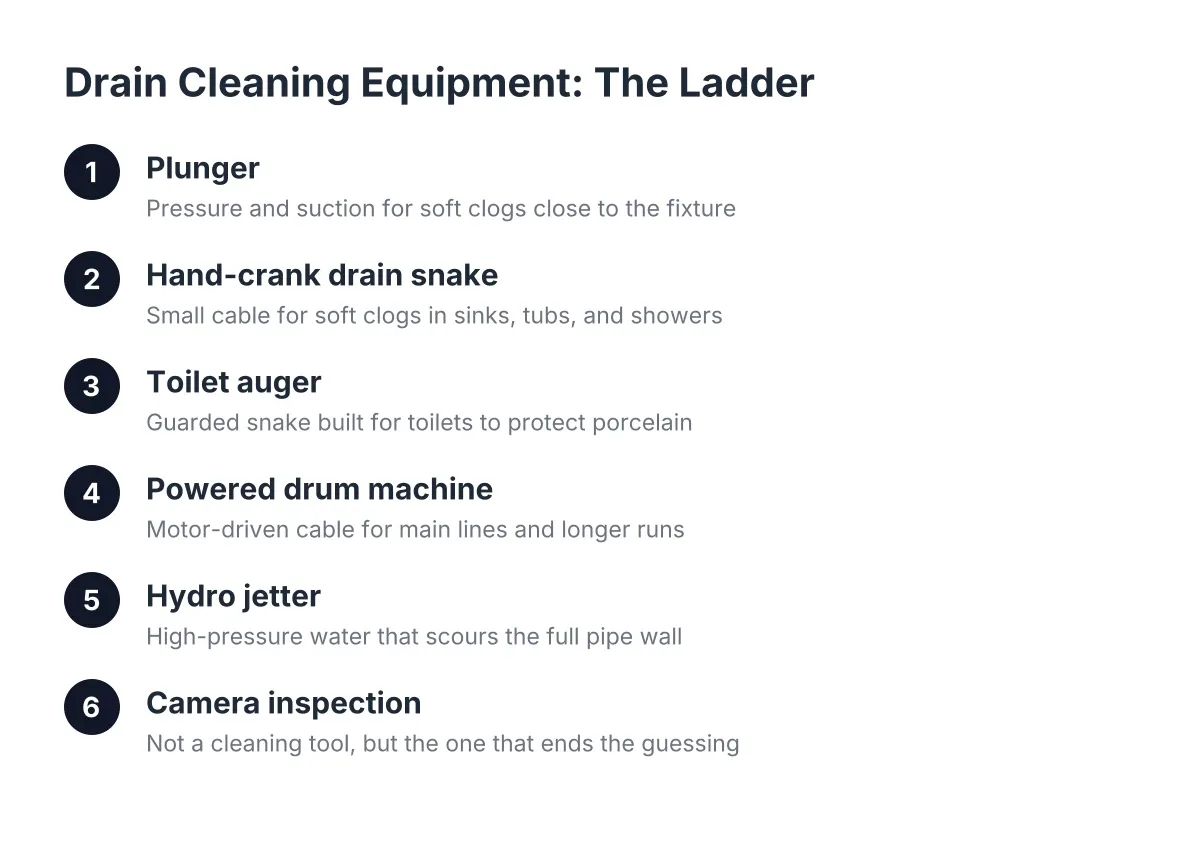
Think of drain tools as a ladder. You start at the bottom rung and only climb when the rung below fails. Each step up costs more, reaches farther, and tells you more about what you are dealing with.
- Plunger: pressure and suction for clogs close to the fixture
- Hand-crank drain snake: a small cable for soft clogs in sinks, tubs, and showers
- Toilet auger: a snake built for toilets, with a guard that protects the porcelain
- Powered drum machine (cabling): a motor-driven cable for main lines and longer runs
- Hydro jetter: high-pressure water that scours the full pipe wall
- Camera inspection: not a cleaning tool, but the one that ends the guessing
The sections below take each one in turn.
Plungers: The First Rung of Drain Cleaning Equipment Types
A plunger clears clogs sitting near the fixture by pushing and pulling water against the blockage. It works on toilets, sinks, and tubs when the clog is soft and close. There are two shapes worth knowing. The flat-cup plunger seals against flat sink and tub drains. The flange plunger has an extended rubber sleeve that seals inside a toilet's outlet, which is why the sink plunger you keep grabbing for the toilet never quite works.
Technique matters more than force. Cover the overflow opening on a sink or tub with a wet rag so your pressure pushes at the clog instead of escaping out the overflow. Keep enough water in the fixture to cover the cup. Then work steadily for fifteen to twenty seconds before checking.
If plunging clears the drain and it stays clear, you are done. If the same fixture clogs again within a week or two, the blockage is farther down the line than a plunger can reach, and it is time to move up the ladder.
Drain Snakes and Augers: The Workhorses
A hand-crank drain snake is a coiled steel cable, usually 15 to 25 feet, that you feed into the drain and turn. The tip either hooks the clog so you can pull it out or breaks it apart so water carries it away. For a single clogged sink, shower, or tub, pull the drain grate, feed the cable, and a soft blockage of paper or waste will usually give way. This is the tool sold at any general retail store, and for one-fixture clogs it earns its keep.
Toilets get their own version. A toilet auger runs the cable through a rigid tube with a rubber or plastic guard at the bend, because a bare cable tip scratches porcelain and leaves permanent gray marks in the bowl. If you have ever wondered why plumbers carry a separate tool just for toilets, that is the reason.
Powered drum machines are the professional step up. A motor spins a longer, heavier cable, often 50 to 100 feet, with interchangeable cutting heads. This is what main line drain cleaning usually means: running a powered cable through a cleanout toward the blockage. On septic properties there is a useful trick worth knowing. If the blockage sits between the house and the tank and the cleanout is damaged or buried, a crew can open the tank lid and run the cable from the tank side back toward the house. It is slower and more tedious, but it reaches clogs the cleanout cannot.
Here is the honest limit of every snake, hand-crank or powered. A cable pokes a hole. Against paper, that hole is the whole fix. Against grease or roots, the hole closes back up, and against a full septic tank or a clogged effluent filter, the cable finds nothing to grab at all.
Hydro-Jetting: Cleaning the Pipe, Not Just Poking It
A hydro jetter pushes water through a hose at high pressure, with a nozzle that sprays backward to pull the hose down the line and blast the pipe walls clean. Where a cable drills a tunnel through a blockage, a jetter scours the entire inside surface of the pipe back to bare wall. That difference is the whole reason the tool exists.
Grease is the clearest case for jetting. Fat, oil, and grease build up in layers on pipe walls, and research estimates 30 to 40 percent of sewer clogs come from these deposits, according to the International Journal of Environmental Science and Technology. The U.S. Environmental Protection Agency found the same pattern at larger scale; grease is the most common cause of reported sewer blockages, at 47 percent. A snake through a grease clog buys weeks. A jetter through the same line removes the coating that keeps re-forming the clog.
Roots are the second case. A heavy root ball in a sewer line will shrug off cabling, and when the cable alone cannot clear the obstruction, jetting is the tool that finishes the job. The same logic applies to commercial kitchens and their lines; a single restaurant can send 800 to 17,000 pounds of grease into a sewer system in a year if the grease trap is neglected, per the U.S. Environmental Protection Agency, which is why grease trap cleaning and jetting often travel together.
The trade-off is that jetting is not a homeowner tool. The pressures involved can damage old, brittle, or already-cracked pipe, and an experienced operator should assess the line first, ideally with a camera. If a camera reveals a collapsed or badly cracked section, no cleaning method fixes it; you are into repair territory, where sewer pipe lining cost per foot becomes the number that drives the decision between lining and excavation.
Cameras: The Tool That Ends the Guessing
A sewer camera is a waterproof lens on a push cable with a locator beacon. It does not clear anything. What it does is answer the two questions everything else depends on: where is the problem, and what is it? Roots, grease, a sag in the line, a crushed section, or a line that runs clear all the way to a struggling septic tank. On septic properties, a camera run that finds no obstruction is itself the diagnosis; it means the problem is the system, not the pipe.
For anyone building new on vacant land, cameras have a second life. A camera run on new drain lines before final inspection catches construction debris, low spots, and crushed sections while the trenches are still open and cheap to fix.
When No Drain Cleaning Equipment Will Fix It
No drain tool clears a full septic tank, a clogged effluent filter, or a failing drain field. These are the three problems that mimic a main line clog on septic properties, and they are the reason a snake can come back clean while the toilets still gurgle. If every fixture in the house is slow and the line to the tank is open, the system itself needs attention.
This is the most common and most expensive mistake on septic properties around Fontana. A homeowner sees a backup, calls for drain cleaning, a crew runs a snake through the cleanout, and nothing changes, because there was never a line obstruction to clear. A clogged effluent filter sits inside the tank. Additionally, a saturated drain field sits under the yard. Furthermore, a cable cannot touch either one.
Watch for the pattern instead of the single symptom:
- Multiple fixtures slow at once, especially the lowest drains in the house
- Gurgling from one drain when another fixture runs
- Sewage odor near the tank lids or over the drain field
- Soggy ground or unusually green grass over the field
- Backups that return quickly after a line has been cabled clean
Any two of those together point at the septic system, not the pipe. The right responses are a septic system inspection and, in many cases, a pump-out, not another pass with a cable. The economics favor catching it early. According to the U.S. Environmental Protection Agency, routine septic maintenance runs $250 to $500 every three to five years, while repairing or replacing a failed conventional system runs $5,000 to $15,000. There is one more quiet culprit worth checking: a single running toilet can waste up to 200 gallons of water per day per the U.S. Environmental Protection Agency, and on septic that water floods the drain field around the clock. In addition, skip the tank additives that promise to dissolve sludge; university extension research, including from Washington State University Extension, finds no strong scientific backing for them. Pumping removes solids. Nothing poured down a drain does.
What This Means If You Are Building on Unsewered Land
If you are a builder or an owner putting a new home on a parcel without sewer hookup, the drain tool conversation starts before the first fixture is set. A conventional system has two main components, the septic tank and the drain field, according to the U.S. Environmental Protection Agency, and both get sized and sited off a percolation test. Per University of Nebraska-Lincoln Extension, that perc test must be dug and performed before installation to confirm how well the soil drains, which is exactly why the county health department wants it before your building permit moves.
Design details you approve on paper become drain problems or non-problems for the next twenty years. The drain field itself is built in layers: a thick bed of gravel, perforated pipes laid on top, more gravel over the pipes, then soil, according to US EPA. Inside the tank, baffles at the inlet and outlet, downward-facing tees with pipe sections, force solids to settle instead of floating toward the outlet, per University of Nebraska-Lincoln Extension. A missing or broken outlet baffle sends solids straight into that gravel field, and no drain cleaning equipment on this list can pull them back out. Field damage of that kind usually means excavation.
For a concrete picture, suppose a small builder is closing out a four-lot project in the unincorporated county land near Fontana in 2026. The smart pre-handoff checklist is short: camera the drain lines from each house to each tank to catch debris and low spots, confirm the effluent filter is installed and accessible, verify both baffles, and photograph the lid and cleanout locations for the owner packet. In that scenario, an hour of checking per lot spares the builder the warranty call six months later when a buyer's "clogged drain" turns out to be a construction rag lodged in the building sewer, and it spares the buyer a service visit that ends with "the line is clear, the problem is something else."
Matching the Equipment to the Problem
Pull the whole ladder together and the decision path is short. Start with location, then material, then the right rung.
- One slow fixture, soft clog: plunger first, then a hand-crank snake through the drain opening
- Clogged toilet: flange plunger, then a toilet auger, never a bare cable against porcelain
- Main line blockage, paper or waste: powered cabling through the cleanout, or from the tank side if the cleanout is unusable
- Grease or roots in the main line: hydro-jetting, because cabling alone leaves the pipe wall coated and the clog comes back
- Repeat clogs with no clear cause: camera inspection before spending more on cleaning
- Whole-house symptoms with a clear line: septic system inspection and likely a pump-out, because the problem is not in the pipe
Knowing drain cleaning equipment types helps you ask the right questions of professional services. The plunger and the hand snake belong in your garage. The drum machine, the jetter, and the camera belong on a truck, run by someone who works these lines and these systems regularly. Notably, the real value of understanding the tools is knowing what to ask for, recognizing when a crew reaches for the wrong one, and spotting the moment a drain problem stops being a drain problem and becomes a septic one. In Fontana and the unsewered parcels around it, that judgment call, made early, is the cheapest fix on this entire list.
If you need septic tank pumping, Fontana Septic can help.
Prefer to talk it through? Call (909) 316-2368 — a quick call is usually the fastest way to get a straight answer for your situation.