
What Causes Residential Drain Clogs: Hair, Grease, Roots, and Septic Trouble
If you own a home on a septic system, the causes of residential drain clogs matter more to you than to a house on city sewer. Understanding septic drain clog causes is critical because a clog in a sewer home is an annoyance, but the same clog in a septic home can be the first warning that your tank is full or your leach field is struggling. This list breaks down the seven most common culprits, from hair and grease to tree roots, and shows you how to tell a simple pipe blockage from a septic system problem that needs a pump-out, not a snake.
Here in Fontana and the surrounding rural pockets like Bloomington and Glen Avon, most lots run on private septic. That changes the diagnosis. Run through this list before you pay anyone, and you will know which fix to ask for.
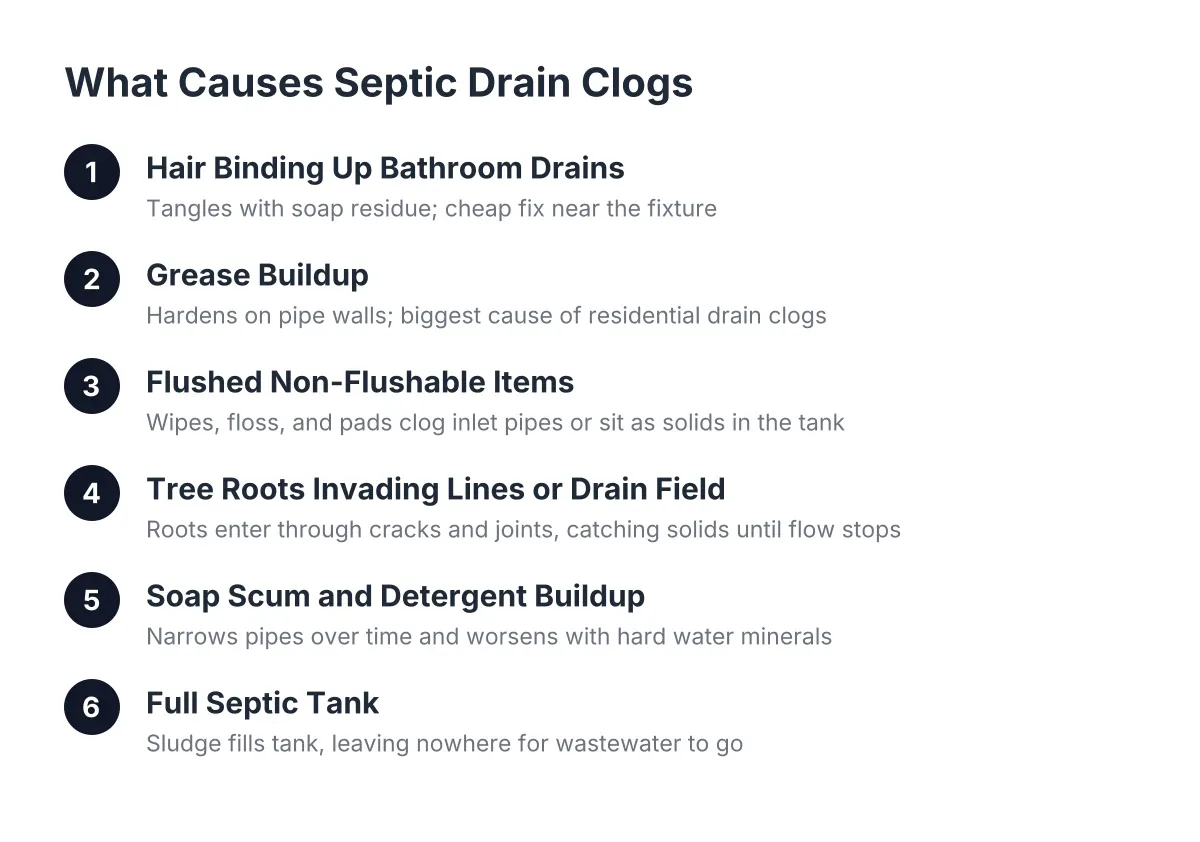
1. Hair Binding Up Bathroom Drains
Hair is the top cause of slow bathroom sink, tub, and shower drains. It does not dissolve, and it tangles with soap residue to form a mat that catches everything else flowing past. The good news is that hair clogs sit near the fixture, so they are cheap to fix.
You can usually pull a hair clog with a plastic barb tool or a small hand auger in ten minutes. If one shower drain runs slow but every other drain in the house works fine, hair is the likely cause, and your septic system is almost certainly not the problem. A drain screen costs a few dollars and stops most of these clogs before they start.
2. Grease, the Biggest Cause of Residential Drain Clogs
Cooking grease is the most damaging thing homeowners pour down a kitchen drain. It goes in as a warm liquid, then cools and hardens on the pipe walls. According to the U.S. Environmental Protection Agency, grease from restaurants, homes, and industrial sources is the most common cause of reported sewer blockages, at 47 percent. Research published in the International Journal of Environmental Science and Technology estimates 30 to 40 percent of sewer clogs come from fat, oil, and grease deposits.
Grease clogs are harder to clear than paper or hair clogs. A snake punches a hole through the blockage, but the grease coating stays on the pipe walls and the clog rebuilds within weeks. Clearing grease for good usually takes a tool that scrubs the full pipe wall, such as a hydro jetter, rather than an auger alone. That is why grease is worth naming as the leading answer when people ask what causes residential drain clogs.
For septic homes, grease does double damage. Inside your tank, fats, oils, and grease float to the top and form a scum layer, according to the U.S. Environmental Protection Agency. Pour enough grease and that layer thickens fast, shortens your pumping interval, and can push grease out into the drain field where it clogs soil. Wipe pans with a paper towel and trash it. Your pipes and your tank will both last longer.
3. What Causes Septic Drain Clogs: Flushed Items That Never Break Down
Wipes, feminine products, dental floss, cotton swabs, and paper towels do not break down the way toilet paper does. In a sewer home, they snag in the main line. In a septic home, they either clog the inlet pipe or sit in the tank as solids that never digest.
Most septic problems trace back to what went down the drain, particularly grease and non-flushable items, rather than to the system itself failing. The fix is a house rule, not a tool: toilet paper and human waste only. If you are wondering how to unclog a toilet that keeps backing up, a plunger or closet auger handles the one-time clog, but repeat clogs point to something further down the line.
4. Tree Roots Invading the Sewer Line or Drain Field
Roots are the heavyweight cause on rural lots. The main line from your house to the tank, and the perforated pipes in your leach field, both carry nutrient-rich water that roots seek out. Roots enter through pipe joint separations and small cracks, then grow into a net that catches solids until the line closes off.
Here is the trade-off to understand before you pay for service. Snaking a root-invaded line cuts the roots and restores flow, but roots regrow aggressively, so a badly damaged or partially collapsed pipe will clog again and again. At that point the honest fix is pipe repair or replacement, not another snaking. A camera inspection tells you which situation you have; most sewer line clogs trace to joint separations, cracks, or root intrusion rather than debris alone, so it is money well spent before you commit to a bigger repair.
The same logic applies to the drain field. A septic drain field is built from perforated pipes laid in gravel and buried under soil, according to the US EPA, and roots that reach those pipes can choke the whole field. Determining whether a field problem is roots, a collapsed pipe, or soil failure takes a camera or excavation, not guesswork.
5. Soap Scum and Detergent Buildup
Soap and detergent residue clings to pipe walls the same way grease does, just slower. Over years, the buildup narrows the pipe and gives hair and food particles something to grab. Hard water makes it worse because minerals bond with soap to form a crusty scale.
In a septic home, detergent and grease buildup inside the outlet pipe is a known contributor to backups and reduced flow leaving the tank. Therefore, if your whole house drains slowly and the tank was pumped recently, ask the crew to check the outlet side, not just the line from the house.
6. Understanding What Causes Septic Drain Clogs: A Full Tank
This is the cause that separates septic homeowners from everyone else. In a septic system, one pipe carries all household drains to the tank, where solids settle and are later removed by pumping, according to the US EPA. When the tank fills with sludge, there is nowhere for new wastewater to go, and every drain in the house slows at once.
The pattern is the tell. One slow drain means a local clog. Every drain slow, gurgling toilets, sewage odor near the tank, or soggy patches over the leach field mean septic trouble. No amount of drain cleaning fixes a full tank; you need septic tank pumping. Searching "sewer drain cleaning near me" and hiring a crew to snake the line wastes money if the real problem is a tank that has not seen a pump-out in six years.
Suppose a homeowner in Bloomington on a half-acre lot notices the kitchen sink and both bathrooms all draining slow the same week. In that scenario, a routine pump-out in the estimated $300 to $600 range likely solves it. Skipping it risks the expensive outcome: EPA guidance puts the cost of repairing or replacing a failed conventional system at $5,000 to $15,000, versus $250 to $500 for maintenance every three to five years.
One more thing worth checking first. A clogged inlet baffle is a common cause of septic backups and should be one of the first things checked when troubleshooting a blocked line into the tank, according to the Washington State Department of Health. It is a fast check for anyone opening the tank lid, and it saves you from snaking a line that is not actually clogged.
7. Fixture and Line Problems That Mimic Clogs
Not every drainage symptom is a blockage. A running toilet can waste as much as 200 gallons of water per day, according to the U.S. Environmental Protection Agency, and on a septic system that extra water floods the tank and drain field until drains back up with no clog anywhere. Bellied pipes, where a section of line sags and holds water, cause chronic slow spots that snaking never fixes.
Recurring clogs at the same bend in the same pipe point to a chronic defect, not bad luck. A snake through the clean-out also will not fix a clogged effluent filter or a failing drain field, because those are not line obstructions a cable can reach. When the same symptom returns three times, stop paying for the same fix and get a camera inspection or a septic system inspection instead.
How to Match the Cause to the Right Fix
Use the symptom pattern to sort the causes of residential drain clogs before you call anyone. Here is the short version:
- One slow fixture: hair or soap clog near the drain. DIY tool or basic drain service.
- Kitchen sink clogging repeatedly: grease coating the pipe. Jetting beats snaking for a lasting fix.
- Whole house slow, gurgling, or odors: septic tank likely full. Pumping, not snaking.
- Clogs that return in the same spot: root intrusion or pipe damage. Camera inspection first.
- Soggy yard over the leach field: drain field trouble. Septic system inspection, possibly repair.
A word on the tool debate people search for, hydro jetting versus snaking. A snake is faster and cheaper, and it is the right call for hair, paper, and one-time blockages. Jetting scrubs the pipe wall clean, which is what grease and heavy buildup require, but it costs more and needs a pipe in decent condition. Neither one helps a full tank or a failed field.
Skip the additive shortcut too. Commercial septic tank additives marketed to dissolve sludge lack strong scientific backing, according to Washington State University Extension. Pumping removes sludge; nothing you pour in does.
When a Fontana Septic Home Should Call for Help
Search results for "drain cleaning near me" will hand you national dispatch brands that treat septic as an afterthought. For a septic-dependent home in Fontana, that ordering is backwards. If the symptoms point to the tank or the leach field, start with a local septic pumper who can open the tank, check the baffles and sludge levels, and tell you plainly whether you need a pump-out, a line cleared, or a repair.
For new construction owners putting in a system as of 2026, this list doubles as a design lesson. Keep trees away from the drain field, plan cleanout access, and set a pumping schedule from day one, because the causes above are the reasons systems fail early. If you are unsure whether your symptom is a clog or a septic failure, or if sewage is backing up into the house, stop troubleshooting and get a professional on site; misdiagnosing a failing drain field as a simple clog is the most expensive mistake on this list.
If you need septic tank pumping, Fontana Septic can help.
Prefer to talk it through? Call (909) 316-2368 — a quick call is usually the fastest way to get a straight answer for your situation.