
Old Septic Tank Design Flaws: 8 Common Failures and How to Fix Them
If your home sits on an old septic tank design, the problems you deal with today were often built in decades ago. Single-chamber tanks, missing baffles, undersized capacity, and brittle lids all cause failures that look like emergencies but trace back to the drawing board. This list walks through eight design flaws we see in older tanks around Fontana, what each one does to your system, and what your repair options actually are.
Most of these flaws can be managed. A few mean the tank needs to go. Knowing which is which can save you from paying emergency prices for a problem that routine service would have caught, or from pumping a tank over and over when the real issue is a clogged drain field.
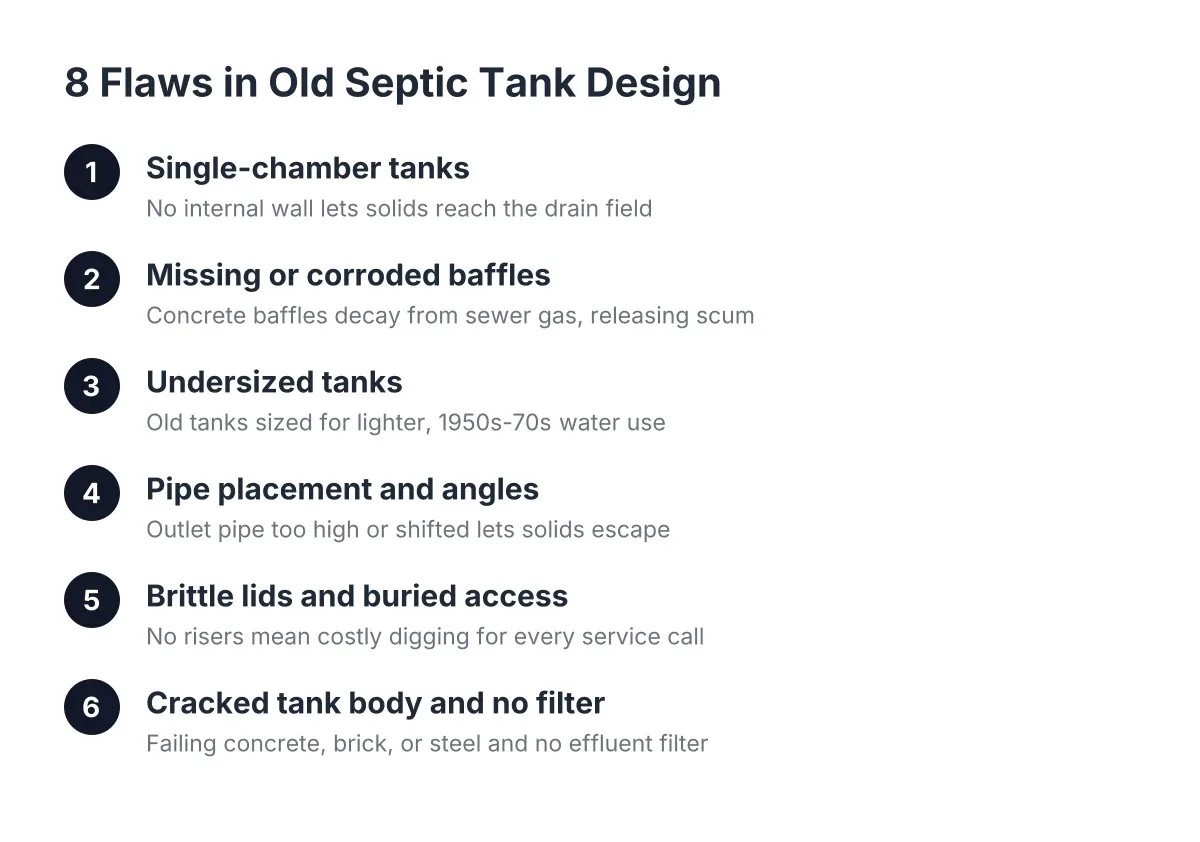
1. Single-Chamber Tanks Let Solids Reach the Drain Field
The biggest flaw in old septic tank design is the single open chamber. A conventional system has two main components, the tank and the drain field, according to the U.S. Environmental Protection Agency. The tank's whole job is to hold solids back so only clarified liquid flows out. A single chamber with no internal wall gives solids a straight shot toward the outlet, especially when the tank is due for a pump-out.
Older properties sometimes handled this with two separate tanks plumbed in a line, which worked on the same principle. Most modern tanks use a single body with an internal baffle wall creating two chambers. The first chamber catches the heavy solids; the second gives the liquid a calmer place to settle before it leaves.
Repair options: a single-chamber tank is not automatically a replacement job. More frequent septic tank pumping keeps solids low enough that they never reach the outlet. An outlet filter can be added in many tanks as a second line of defense. However, if solids have already pushed into the drain field lines, that damage usually cannot be reversed.
2. Missing or Corroded Baffles Are the Silent Failure Point
Baffles do the real work inside a septic tank. According to University of Nebraska-Lincoln Extension, tanks use a baffle at both the inlet and the outlet, a downward-facing tee that forces solids to settle to the bottom instead of floating out. Many old tanks were built with concrete baffles cast into the walls, and decades of sewer gas eat concrete.
When the outlet baffle crumbles, floating grease and scum ride straight out to the leach field. The homeowner never sees it happen. The first sign is usually a slow drain, then a backup, often years after the baffle actually failed.
Repair options: a failed baffle is one of the cheapest design flaws to fix. A septic tank inspector can check baffle condition during a pump-out, when the tank is empty and visible. Replacing a corroded concrete baffle with a PVC tee is a standard repair, and it is far cheaper than a new drain field.
3. Undersized Tanks Cannot Keep Up With a Modern Household
Tanks from the 1950s through the 1970s were sized for households that used less water and produced less solid waste. Dishwashers, garbage disposals, and daily laundry were not the norm. Today, San Bernardino County's minimum capacity table requires a 1,000-gallon tank for a 3-bedroom home and 1,500 gallons for a 5-6 bedroom home, according to the San Bernardino County Department of Public Health. Plenty of older Fontana-area tanks fall well under that.
An undersized tank does not give wastewater enough time to settle. Solids stay suspended, bacteria cannot keep pace, and the sludge layer climbs faster than the pump-out schedule assumes.
Repair options: you cannot make an old tank bigger, but you can pump it more often and cut the load. Fixing leaks matters more than people think; a single running toilet can waste up to 200 gallons of water per day, according to the U.S. Environmental Protection Agency, and all of it flows through your tank. If the household has outgrown the tank, adding a second tank in series or replacing it outright are the long-term fixes.
4. Problems With Old Septic Tank Design in Pipe Placement and Angles
A properly designed outlet pipe sits lower than the inlet pipe, because solids float on top of the liquid and only the liquid should exit toward the drain field, according to University of Nebraska-Lincoln Extension. Some older tanks were built or repaired with the outlet too high, or the tank has settled over the decades and changed the pipe angles.
In addition, old installations often skipped proper compaction around the pipe penetrations. Soil settles, pipes shift, and the connection point cracks or sags. A sagging inlet line collects solids and causes backups that look like a full tank when the tank is fine.
Repair options: pipe grade and connection problems show up clearly during a septic system inspection with the tank open. Re-setting a pipe or repairing a cracked connection is a targeted repair, not a system replacement. This is one reason an inspection before you panic-pump is worth the time.
5. Brittle Lids and Buried Access Make Every Service Call Harder
Here is a design flaw you feel in your wallet every time you call a septic pumper. Old tanks were buried with no risers, so the crew has to locate the tank and dig to reach the lid. Worse, gas buildup inside the tank corrodes some lid styles from the inside. The lid looks solid until it cracks under a pry bar, and now a routine pump-out includes a lid replacement.
Say a Fontana homeowner has toilets backing up on a Saturday with guests arriving. In that scenario, a tank with risers brought to grade gets opened and pumped quickly. A tank buried 18 inches down with no records means the crew spends the first hour just finding it. Same emergency, different bill.
Repair options: add risers during your next pump-out. It is a one-time upgrade that makes every future inspection and pumping visit faster and cheaper. The trade-off is a visible lid at grade in your yard, which most owners accept once they have paid for exploratory digging twice.
6. Cracked Concrete, Old Brick, and Steel: When the Tank Body Itself Fails
Old concrete septic tank designs become brittle with age, and a vehicle driving over the tank can crack it outright. Brick-lined tanks, common in homes from the early 1900s, were never watertight by modern standards; some were closer to cesspits than true tanks. Steel tanks from mid-century builds rust from the inside until the top or baffles collapse.
A cracked tank found during a home inspection may still be holding and functioning. Even so, buyers, lenders, and county health officials rarely accept a cracked tank, and replacement is the usual outcome once a crack is documented.
Repair options are limited here. Minor cracks above the waterline can sometimes be sealed; structural cracks, collapsed steel, or failing brick mean replacement. According to the U.S. Environmental Protection Agency, repairing or replacing a failed conventional system runs $5,000 to $15,000, while regular maintenance costs $250 to $500 every three to five years. That gap is the whole argument for catching cracks early.
7. No Effluent Filter Means the Drain Field Takes Every Mistake
Modern tank designs include an effluent filter at the outlet, a simple screen that catches suspended solids before they leave the tank. Old tanks have nothing there. Every grease mistake, every load of lint, every bout of heavy use flows straight toward the leach field.
The drain field is the part you cannot easily fix. After separation in the tank, liquid is distributed through perforated lateral pipes and filtered through gravel, sand, and soil, according to the U.S. Environmental Protection Agency. Once solids clog those lines and the soil around them, the lines generally cannot be salvaged and must be replaced.
Repair options: many older tanks can be retrofitted with an outlet filter, which then needs cleaning at each pump-out. For households that cook with a lot of fat and oil, a grease trap and regular grease trap cleaning cut the load before it ever reaches the tank.
8. Lost Records and Mystery Layouts Turn Small Problems Into Big Ones
Plenty of old systems have no as-built drawings, no permit record, and no one alive who remembers where the drain field runs. Septic tank shapes and configurations vary by region; some areas used rectangular concrete tanks, others circular ones, according to the International Code Council. On an old Fontana-area parcel you might find any of them, or a second abandoned tank nobody mentioned.
For builders and developers working unsewered parcels, this matters too. An undocumented old system on a lot has to be located, pumped, and properly abandoned before new septic tank design and county approval can move forward. Pumped waste does not stay on site; it is trucked to a sewage treatment plant for disposal, per the New Hampshire Department of Environmental Services, so abandonment is a planned step, not an afterthought.
Repair options: a septic system inspection that locates and maps the tank, lines, and drain field gives you a record you keep forever. Mark the lids, note the measurements, and every future service call starts an hour ahead.
Identifying Flaws in Old Septic Tank Design Systems
Start with symptoms, then confirm with an inspection. The patterns usually sort out like this:
- Slow drains throughout the house that improve right after a pump-out point to an undersized or overdue tank.
- Backups that return within weeks of pumping suggest solids in the drain field or a failed outlet baffle.
- Wet, smelly patches in the yard over the leach field mean the field is struggling, whatever the cause.
- Sewage smell near the tank with no drainage problems can mean a cracked lid or failed seal.
- One slow fixture, not the whole house, is often a plumbing clog, not a septic problem at all.
However, symptoms overlap, and guessing wrong gets expensive. A tank that keeps backing up might need a $300 baffle repair or a full drain field, and you cannot tell from the kitchen sink. Have a septic tank inspector open the tank and look before anyone quotes you a replacement, especially if the quote arrives during an emergency when you feel pressure to say yes.
The honest summary: old septic tank design flaws are predictable, and most of them are manageable with routine pumping, a baffle or filter upgrade, and a mapped layout. The systems that fail completely are usually the ones nobody serviced for decades, because septic tanks do not last indefinitely without pumping. If your tank predates the 1980s and has never had a documented inspection, that inspection is the single most useful thing you can schedule before the next backup schedules it for you.
If you need septic tank pumping, Fontana Septic can help.
Prefer to talk it through? Call (909) 316-2368 — a quick call is usually the fastest way to get a straight answer for your situation.