
How Septic Tank Design Affects Maintenance and Pumping Frequency in Fontana
If you own rental homes on septic in the Fontana area, you already know the real cost of a system is not the pump-out. It is the tenant call at 7 p.m. about a slow drain, the scramble to find a septic pumper, and the risk that a backup turns into a habitability complaint. Here is the part most owners never hear: tank design affects maintenance more than almost anything else on the property, and the tank's design directly influences the pumping frequency you'll need. Understanding tank design and pumping frequency is essential because the layout of the tank, the baffles, the outlet, and the access lids decides how often you pump, how long the leach field lasts, and how expensive your surprises get.
This guide walks through how that works in plain terms. It covers what good design looks like, where older tanks go wrong, and how to use that knowledge to set a pumping schedule across several properties. It is written from the point of view of a local crew that pumps and inspects tanks of every age and style around Fontana, not a design textbook.
Why Tank Design Affects Maintenance Costs Over Time
A septic tank has one main job: hold wastewater still long enough for solids to settle and grease to float, so only clarified liquid leaves for the drain field. According to the US EPA, a typical residential system has just two main parts, a tank that clarifies wastewater and a drain field that disperses the liquid into the soil. Everything about maintenance flows from how well the tank does that one job.
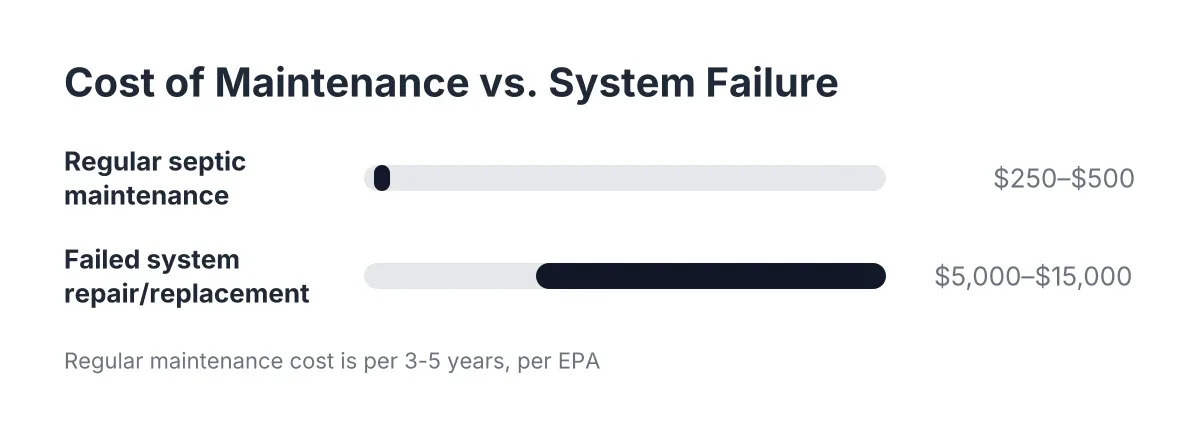
When the design works, solids stay in the tank where a pump truck can remove them. When the design is wrong, solids escape to the drain field. That is the difference between a routine pump-out every few years and a dug-up yard. EPA guidance puts the stakes in dollars: regular septic maintenance costs $250 to $500 every three to five years, while repairing or replacing a failed conventional system runs $5,000 to $15,000, according to the U.S. Environmental Protection Agency.
For a landlord with three rentals on septic, that math compounds. Three well-designed, well-maintained tanks might cost a few hundred dollars each on a rotating pump-out schedule. One tank with a failed outlet baffle can send solids into a leach field for years without a visible symptom, then present you with a five-figure repair and an unhappy tenant at the same time.
Here is the core idea to carry through the rest of this article. Tank design affects maintenance in three specific ways: how fast solids accumulate relative to usable tank volume, how well the tank keeps solids away from the outlet, and how easy the tank is to inspect and pump when the truck shows up.
Design Features That Influence Tank Pumping Frequency
Four parts of a septic tank design decide most of your maintenance outcomes. None of them are exotic. The problem is that on older tanks, one or more of them is often missing, broken, or buried.
Inlet and outlet baffles
Baffles are the quiet workhorses of a septic tank. According to University of Nebraska-Lincoln Extension, tanks use a baffle at both the inlet and the outlet, built as a downward-facing tee with a pipe section. The inlet baffle directs incoming wastewater down into the tank so it does not shoot across the surface. The outlet baffle stops the floating scum layer from riding out the exit pipe toward the drain field.
When an outlet baffle rots away, which happens on older concrete tanks where the baffle was cast concrete, nothing stops grease and solids from leaving the tank. The system keeps draining fine. Tenants notice nothing. Meanwhile the drain field is slowly clogging. By the time a slow drain shows up, the damage is often done. This is the single most common design-related failure a septic tank inspector finds on older Fontana-area systems.
Outlet elevation
The outlet pipe must sit lower than the inlet pipe. According to University of Nebraska-Lincoln Extension, solids float on top of the liquid in the tank, and only the liquid should exit toward the drain field. That elevation difference keeps the water surface below the inlet, so incoming flow drops into the tank instead of backing up the line.
On a tank that has settled or was set out of level, that relationship can break. The symptom is often recurring backups at the house even when the tank is not full. A pump-out fixes it for a few months, then the problem returns. If one of your rentals has needed pumping twice in a year, elevation and settling are worth checking before you pay for a third truck visit.
Tank volume and compartments
Volume buys settling time. San Bernardino County's minimum capacity table requires a 1,000-gallon tank for a 3-bedroom home and 1,500 gallons for a 5-6 bedroom home, according to the San Bernardino County Department of Public Health. A tank sized below the household's actual use fills with solids faster, which means more frequent pump-outs or more solids carryover to the field.
Two-compartment tanks, standard in newer designs, add a second settling stage. The first compartment catches most solids; the second polishes the liquid before it exits. Older single-compartment tanks can work fine, but they leave less margin for error when a baffle fails or a tenant household runs heavy. Shapes vary too; according to the International Code Council, some regions use rectangular concrete tanks while others use circular ones, and both can perform well when the internals are intact.
Access risers and lids
This one gets overlooked because it has nothing to do with how sewage moves. It has everything to do with what service costs. A tank with risers brought to grade can be opened, inspected, and pumped in minutes. A tank buried 18 inches under a tenant's lawn needs locating and digging on every single visit, and you pay for that time every time.
For a multi-property owner, risers are one of the cheapest upgrades with the clearest payback. They also make it far more likely that a crew inspects both compartments and checks the baffles during a pump-out, instead of pumping through the one lid that was easy to reach.
How Tank Design and Pumping Frequency Work Together in Practice
Pumping frequency is not a fixed number. It is the output of three inputs: tank volume, household size, and how well the design keeps solids where they belong. Penn State Extension's general guidance is that an active family of four should pump every two to three years because of higher solids and liquid production. A smaller household in a properly sized tank can often stretch longer; a full house in an undersized or single-compartment tank cannot.
There is a balance to strike here. Pumping too rarely lets solids build until they reach the outlet and escape to the field. Pumping more often than the tank needs just burns money, which matters when these costs come out of rental margins. The right interval for each property comes from measuring sludge and scum depth at a pump-out, not from guessing.
Water load matters as much as solids. According to the U.S. Environmental Protection Agency, a single leaky or running toilet can waste as much as 200 gallons of water per day. That extra flow pushes wastewater through the tank faster, cuts settling time, and carries solids toward the outlet. In a rental, a running toilet the tenant never reports can quietly undo a good tank design. A simple line in your lease asking tenants to report running toilets and slow drains protects the septic system as much as the water bill.
Grease deserves its own mention. Fat, oil, and grease are a leading cause of line problems; research in the International Journal of Environmental Science and Technology estimates 30-40% of sewer clogs come from grease deposits in pipes. In a septic context, grease thickens the scum layer and tests the outlet baffle. Tenant kitchens produce plenty of it, which is another reason the baffle check during inspection matters.
A worked example across three rentals
Suppose a landlord owns three rental houses in the Fontana area. Property A is a 3-bedroom on a modern 1,000-gallon two-compartment tank with risers at grade, where tank design and pumping frequency allow a longer interval. Property B is a 3-bedroom on a 1970s single-compartment concrete tank, lids buried, outlet baffle condition unknown. Additionally, property C is a 4-bedroom with a tank that may be undersized for its current occupancy of six people.
In that scenario, a sensible plan is not one schedule for all three. Property A might settle into a pump-out every three to four years, confirmed by sludge measurements. Property B gets risers installed at the next pump-out and a baffle inspection; if the concrete baffle is gone, a replacement tee is a modest fix that protects the leach field. Furthermore, property C gets pumped on a shorter cycle, every two years or less, because occupancy outruns the tank volume. Same owner, three different maintenance intervals, all driven by design.
That is the practical payoff of understanding this topic. You stop treating pumping as a reaction to tenant complaints and start treating it as a schedule set by each tank's design and load.
Where Older Designs Create Recurring Problems
Many homes on septic around Fontana and the surrounding unincorporated county areas date back decades, and the tank in the ground reflects the standards of its era. Knowing the common weak points of old septic tank design helps you decide what to check first on a property you already own or one you are about to buy.
The usual trouble spots, roughly in the order a crew checks them:
- Missing or deteriorated outlet baffles, especially cast concrete baffles that have crumbled
- Single-compartment layouts with no second settling stage
- Undersized volume relative to current bedroom count or occupancy
- No risers, so lids sit buried and inspections get skipped for years
- Settling or damage where pipes enter the tank; as Onsite Installer notes, fill around pipe penetrations must be compacted thoroughly at installation to prevent exactly this failure
- Steel tanks with rusted-through baffles or lids, a safety issue as well as a performance one
None of these automatically mean replacement. Most of the time, a design weakness just changes the maintenance plan. A single-compartment tank with a sound baffle gets pumped more often. A tank without risers gets them added. An old system managed this way can keep serving the property; regular pumping and keeping wipes, grease, and other inappropriate materials out of the drains are the primary ways to extend the working life of an old absorption system.
The drain field is the part you are protecting with all of this. According to the U.S. Environmental Protection Agency, after separation in the tank, wastewater moves through perforated lateral pipes into the absorption field, then filters through gravel, sand, and soil. The field has no pump truck equivalent; once it clogs with solids, repair means excavation. Regular pumping exists to protect that field, and the tank's design decides how much protection each pump-out buys.
One honest limitation: you cannot assess baffles, compartments, or sludge depth from the surface, and probing an unknown tank yourself is a safety risk. Tank gases are dangerous and old lids can collapse. Condition assessment is a job for a septic system inspection with the tank open, not a weekend project.
How a Design-Aware Service Pattern Works
Once you accept that tank design affects maintenance intervals, the service pattern for a rental portfolio becomes a repeatable process rather than a series of emergencies. As of 2026, here is the sequence that makes sense for an owner bringing several septic properties under control.
- Open and document each tank once. A pump-out with inspection establishes tank size, compartment count, baffle condition, lid access, and sludge depth. This is the baseline everything else builds on.
- Fix the cheap design gaps. Replace failed outlet tees, add risers to grade, and correct any settled connection at the tank. These are small line items compared to field work.
- Set a per-property interval. Use measured sludge and scum levels plus occupancy, not a one-size calendar. A two-person tenancy on a 1,500-gallon tank and a six-person tenancy on a 1,000-gallon tank do not belong on the same cycle.
- Keep the paper. Pump-out receipts, inspection notes, and dates matter for accounting, for resale, and for showing good faith if a tenant ever raises a habitability concern.
- Re-check design items at every pump-out. Baffles and lids degrade; a tank that passed five years ago is not guaranteed to pass today.
A note on where the waste goes, since tenants and buyers sometimes ask: septic waste pumped from residential tanks is trucked to a sewage treatment plant for disposal, according to the New Hampshire Department of Environmental Services. Nothing stays on site except the system itself.
Skip the shortcut products. Additives marketed as a substitute for pumping do not remove solids from the tank, and a septic system is a biological process that does its own work when it is not overloaded. The money is better spent on the pump truck and the inspection.
For builders and developers working unsewered parcels in the area, the same logic applies in reverse. Choices made at design and installation, tank volume above the county minimum, two compartments, risers to grade, and compacted fill at pipe penetrations, directly shape the maintenance burden the future owner or landlord inherits. Septic tank design approved on paper still has to be set level, backfilled correctly, and made accessible, or the first owner pays for the shortcuts within a few years. Septic is also not a niche concern in California even though it is less common here; EPA data shows about 10% of California households rely on septic systems, and in unsewered zones around Fontana that share is effectively everyone on the street.
What to Do With This on Your Own Properties
The takeaway is simple to state. The tank's design, its volume, baffles, outlet elevation, and access, sets the terms of your maintenance. You cannot change most of those terms cheaply, but you can learn them, patch the fixable gaps, and schedule around the rest.
Therefore, if you have a rental on septic and no record of when it was last pumped or what the tank looks like inside, that baseline inspection is the single most useful next step. It turns an unknown liability into a line item with a known interval. For a Fontana-area owner juggling several properties, that is the difference between managing a schedule and fielding emergencies, and it starts with understanding how design, not luck, drives what your system asks of you.
If you need septic tank pumping, Fontana Septic can help.
Prefer to talk it through? Call (909) 316-2368 — a quick call is usually the fastest way to get a straight answer for your situation.