
DIY Septic System Maintenance: What You Can Do Yourself and When to Call a Pro
If you just bought your first home on septic, here is the honest split: DIY septic maintenance for a homeowner covers most of the day-to-day work, but a few jobs belong to a professional septic pumper, no exceptions. This guide walks through both, step by step, so you know what to handle yourself and when to pick up the phone. No jargon, no scare tactics, just what a Fontana homeowner needs to keep a septic system out of trouble.
First, a quick picture of what you own. According to the U.S. Environmental Protection Agency, a conventional septic system has two main parts: the septic tank and the drain field (some people call it a leach field). Every drain in the house feeds one pipe to the tank. Solids settle in the tank, and the liquid flows out to perforated pipes in the drain field, where the soil finishes the job. That whole process is biological, which is why what you send down the drain matters so much.
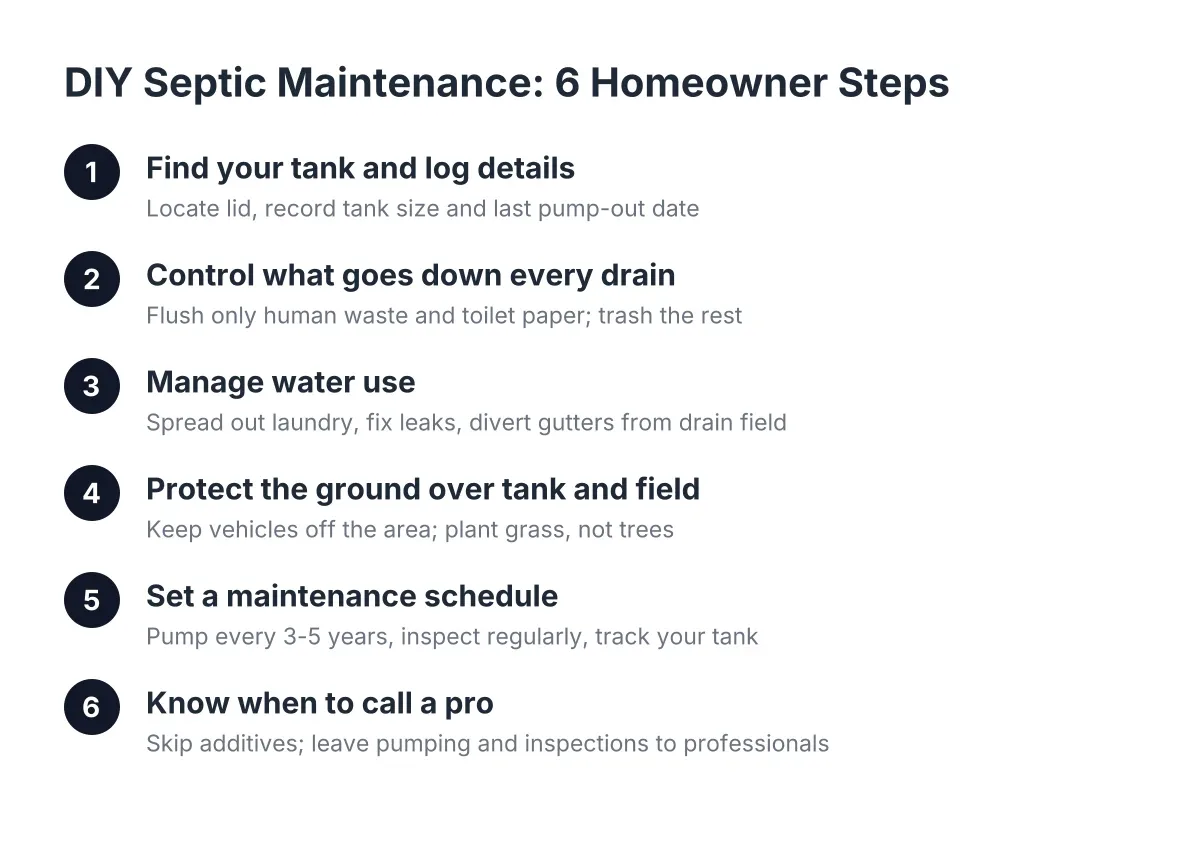
Step 1: Find Your Tank and Write Down What You Know
Start by locating your septic tank and drain field. If your home inspection or the seller's disclosure included a septic diagram, keep it. If not, look for the spot where the main drain line exits the house, then follow that line into the yard. Tank lids are often 10 to 25 feet out, sometimes buried a few inches under grass.
Next, start a simple file. Record the tank size, the last pump-out date, and any repairs the previous owner mentioned. In San Bernardino County, tank size follows bedroom count; the county's minimum capacity table requires a 1,000-gallon tank for a 3-bedroom home and 1,500 gallons for a 5 to 6 bedroom home, according to the San Bernardino County Department of Public Health. If you do not know when the tank was last pumped, treat that as unknown and schedule an inspection sooner, not later.
This file is the cheapest insurance you will ever buy. When a septic tank inspector or pumper shows up, a known lid location and a service history can shave time off the visit.
Step 2: Control What Goes Down Every Drain
This is the core of DIY septic maintenance that every homeowner should master, and it costs nothing. Your tank depends on bacteria to break down waste. Anything that kills those bacteria, or anything that does not break down, works against you.
Flush only human waste and toilet paper. Everything else goes in the trash, including:
- Wipes, even the ones labeled "flushable"
- Paper towels, feminine products, and cotton swabs
- Grease, fats, and cooking oil
- Coffee grounds and food scraps
- Cat litter
- Paint, solvents, and drain-clearing chemicals
- Prescription medications
Grease deserves special attention. Research published in the International Journal of Environmental Science and Technology estimates that 30 to 40 percent of sewer clogs come from fat, oil, and grease deposits in pipes. In a septic system, that grease also forms a scum layer in your tank and can migrate to the drain field, where it clogs soil permanently. Pour cooled grease into a can and throw it out.
For cleaning products, you do not need special "septic safe" everything. Normal household use of standard cleaners is fine. The problem is volume: dumping a gallon of bleach or using heavy antibacterial products daily can knock back the bacteria your tank needs.
Step 3: Manage Your Water Use, Because the Drain Field Feels Every Gallon
Every gallon you send down the drain ends up in your drain field. If the soil gets more water than it can absorb, sewage backs up or surfaces in the yard. So spreading out water use is real maintenance, not a tip.
For example, the U.S. Environmental Protection Agency notes that a single running toilet can waste as much as 200 gallons of water per day. That is 200 gallons your drain field has to absorb for no reason. Fix running toilets and dripping faucets the week you notice them.
In addition, build a few habits:
- Run one or two loads of laundry per day instead of five on Saturday
- Fix leaks fast; a running toilet is a septic problem, not just a water bill problem
- Direct roof gutters and yard drainage away from the drain field
- Skip the garbage disposal, or use it sparingly; food solids fill the tank faster
Step 4: Protect the Ground Over Your Tank and Drain Field
Keep vehicles, trailers, and heavy equipment off the tank and drain field. A septic tank, concrete or plastic, is not built for a truck parked on top of it, and compacted soil over the drain field stops absorbing water. If you are planning a shed, an above-ground pool, or a new driveway, check the system layout first.
Plant grass over the drain field and keep trees at a distance. Roots hunt for water and will find your perforated pipes. Grass is the right cover: it takes up moisture and prevents erosion without root damage.
Step 5: Set a Maintenance Schedule and Put It on the Calendar
A septic tank maintenance schedule is the difference between a routine pump-out and a Saturday backup. Solids build up gradually, and problems develop the same way, so waiting for a visible sign means waiting too long.
How Often Should a Homeowner Handle DIY Septic Maintenance Tasks?
Most household septic tanks need pumping every three to five years, with an inspection at the same visit. According to Penn State Extension, an active family of four should pump every two to three years because of higher solids and water use. Household size, tank size, and habits move the interval, so track your own tank rather than guessing.
Here is a schedule that works for most Fontana homes:
- Monthly: watch for slow drains, gurgling, or sewage odors
- Seasonally: walk the drain field and look for soggy spots or unusually green grass
- Every 1 to 3 years: have the tank inspected and sludge levels checked
- Every 3 to 5 years: schedule a pump-out, or sooner if inspection shows high sludge
Can a Septic Tank Go 20 Years Without Being Pumped?
A septic tank cannot safely go 20 years without pumping. A tank that has never backed up in 20 years is not proof the system is fine; it usually means solids have been flowing into the drain field for years, quietly clogging the soil. The tank might survive that neglect. The drain field often does not, and the drain field is the expensive part.
The math favors the schedule. EPA guidance puts regular septic maintenance at $250 to $500 every three to five years, versus $5,000 to $15,000 to repair or replace a failed conventional system, according to the U.S. Environmental Protection Agency. Skipping a few hundred dollars of pumping to risk a five-figure drain field replacement is a bad trade.
Step 6: Skip the Additives and Spend the Money on Pumping Instead
Do septic tank additives work? For the most part, no, and some do harm. Your tank already has the bacteria it needs from ordinary household waste. No additive removes the settled solids at the bottom of the tank; only a pump-out does that. Some chemical additives can even break up the scum layer and push grease into the drain field.
An occasional biological additive will not hurt a healthy system, and some owners use one as cheap peace of mind. Just be clear about what it cannot do. If a product promises you will never need pumping again, that is a sales pitch, not septic science.
Step 7: Know Where DIY Septic Maintenance Ends and the Pro Begins
Everything above is safe homeowner territory. The line is the tank lid. Never enter a septic tank or lean into an open one; the gases inside can kill a person in minutes. Beyond safety, some jobs need equipment, disposal permits, and trained judgment you cannot buy at a hardware store.
Call a local septic professional for:
- Pumping: the waste has to be hauled by truck to a treatment plant for disposal, according to the New Hampshire Department of Environmental Services, which is why there is no DIY version of a pump-out
- Septic system inspection: measuring sludge and scum layers, checking baffles, and evaluating drain field condition
- Any repair: cracked septic tank concrete, broken baffles, failed lines, or leach field problems
- Backups and sewage on the surface: these are emergencies, not weekend projects
- New installation or replacement: county health department approval, a percolation test, and licensed installation are required, and this is builder and engineer territory, not homeowner territory
There is also a trade-off worth naming. Diligent DIY septic maintenance stretches the time between pump-outs, but it never replaces them, and an owner who skips professional service usually ends up needing pump-outs more often once problems compound. If your system is an aerobic or advanced treatment type, it likely came with a service contract; follow it, because those systems need regular professional attention that a conventional gravity system does not.
Say a first-time buyer closes on a 3-bedroom home in Fontana with a 1,000-gallon tank, and the seller cannot say when it was last pumped. In that scenario, the smart move is a septic system inspection and pump-out in the first few months of ownership, then the habits in Steps 2 through 4, then a calendar reminder three years out. That is the whole routine. Septic system maintenance is not complicated; it is a short list of habits plus a standing appointment with a local pumper who knows your tank.
Handle the habits yourself. Leave the lid, the hose, and the shovel to the crew with the truck. That split keeps a Fontana septic system running for decades instead of failing in the next dry summer.
If you need septic tank pumping, Fontana Septic can help.
Prefer to talk it through? Call (909) 316-2368 — a quick call is usually the fastest way to get a straight answer for your situation.