
Septic System Inspection Before Buying a Fontana Home: What Inspectors Check
A septic system inspection before you buy a Fontana home is the one step that keeps a good deal from turning into a dig-up job in your backyard. The tank and drain field are buried, so problems hide until wastewater backs up into the house. Imagine buyers who skipped this step and, within a month or two of moving in, had to replace a failing system. This guide walks you through the process step by step: what to gather, what the septic tank inspector actually checks, and how to read the results before you sign.
This matters even more if you are buying vacant land or a new build in the unsewered pockets around Fontana, Sunnyslope, or Jurupa Valley. Whether the system is 30 years old or 30 days old, the checks below tell you if it works and if it will pass with the county.
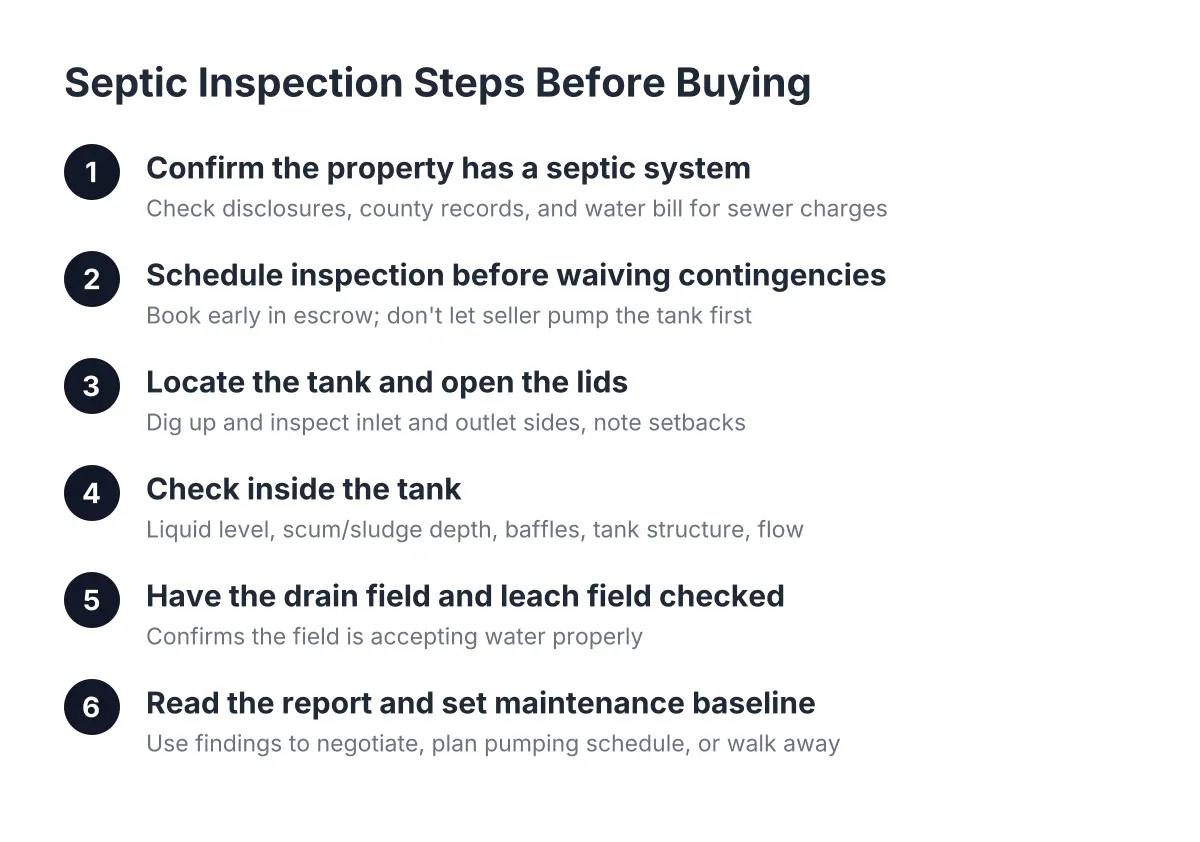
Step 1: Confirm the Property Actually Has a Septic System
First, verify the home is on septic and not municipal sewer. According to the U.S. Environmental Protection Agency, only about 10% of California households use septic systems, so many Fontana buyers assume sewer and get surprised at closing. Check the seller's disclosure, the county records, and the water bill; a home on sewer usually shows a sewer charge.
If the parcel is unsewered, request whatever paperwork exists: the original permit, the as-built drawing showing tank and drain field location, and any pumping receipts. A conventional system has two main parts, a septic tank and a drain field, according to the U.S. Environmental Protection Agency. You want records on both.
For new construction, ask for the perc test results and the county sign-off. A percolation test must be dug and performed before installing a septic system to confirm the soil drains properly, according to University of Nebraska-Lincoln Extension. After the perc test, a local health department inspection is typically required as part of the installation, according to Caroline County Health Department. No paperwork on a new system is a red flag, not a shrug.
Step 2: Schedule the Septic System Inspection Before You Waive Contingencies
Book the inspection early in escrow, not the week before closing. A standard home inspection does not cover the septic system in any real depth; the home inspector may flush a toilet and call it good. You need a dedicated septic inspection for your home purchase before your contingency period runs out, so you still have room to negotiate or walk away.
Expect the inspector to ask preliminary questions before anyone shows up on site:
- How old is the house, and how old is the system?
- When was the last pump-out, and how often has the tank been pumped?
- Any history of repairs, slow drains, or a backup?
- Is the lot flat, on a hilltop, or low-lying near a wash or drainage?
These answers shape what the crew looks for. A house that has never been pumped in 15 years gets a harder look than one with receipts every three years. For an active family of four, pumping every two to three years is generally advisable, according to Penn State Extension, so long gaps in the records tell their own story.
One important sequencing rule: do not let the seller pump the tank right before the inspection. The inspector needs to check the liquid level with the system in its natural, undisturbed state. A freshly pumped tank hides high liquid levels, drain field backflow, and other problems the inspection exists to catch.
Step 3: Locate the Tank and Open the Lids
Next, the crew finds the tank and uncovers it. If the as-built drawing exists, this takes minutes. If not, the inspector probes the yard or follows the main line out from the house. Either way, get the exact location marked and written down before you buy. Knowing where the tank sits keeps a future contractor from excavating over it during a pool dig or an addition.
A real pre-purchase inspection means digging up the lids and looking inside the tank, not checking from the surface. The inspector opens both the inlet and outlet sides and checks each visually. A surface-only walkthrough is not a septic system inspection; it is a guess.
While the lids are open, note the setbacks. Most local regulations require at least 10 feet between the septic system and the building it serves, according to the Minnesota Pollution Control Agency. In San Bernardino County, tank sizing also has to match the home: the county's minimum capacity table requires a 1,000-gallon tank for a 3-bedroom home and 1,500 gallons for a 5-6 bedroom home, according to the San Bernardino County Department of Public Health. An undersized tank on an expanded house is a common finding on older Fontana properties.
Step 4: Know What the Inspector Checks Inside the Tank
Inside the tank, the inspector reads the liquid level first. Liquid sitting at the bottom of the outlet pipe is normal. Liquid above the outlet suggests the drain field is not accepting water. Additionally, liquid below the outlet can mean a leaking tank. Each condition points to a different repair bill, which is why the level gets checked before any pump-out.
After the level check, the inspector works through the rest:
- Scum and sludge depth. Heavy solids near the outlet mean the tank was neglected and solids may have pushed into the drain field.
- Baffles or tees. These keep solids in the tank. Rusted or missing baffles are a common, fixable defect.
- Tank structure. Cracks, corrosion in older steel tanks, and root intrusion at the seams.
- Inlet and outlet flow. Water gets run from the house to confirm it reaches the tank and moves through.
- Backflow after pumping. If the tank is pumped during the inspection, water flowing back in from the outlet side points to a saturated drain field.
A tank in decent shape with worn baffles is a small negotiation item. A saturated drain field is not. That distinction is the whole value of the inspection.
Step 5: Have the Drain Field and Leach Field Checked
The drain field is the expensive half of the system, so do not let it get skipped. The inspector walks the leach field looking for soggy ground, sewage odor, unusually green stripes of grass, and standing water. Any of those suggests the field is failing to absorb wastewater. A thorough septic inspection during your home purchase process will reveal whether the drain field can support the home's long-term use or needs near-term repair.
The stakes here are large. EPA guidance puts routine septic maintenance at $250 to $500 every three to five years, versus $5,000 to $15,000 to repair or replace a failed conventional system, according to the U.S. Environmental Protection Agency. On a purchase, a failed leach field is the difference between a normal escrow and a five-figure credit request.
Inside the house, small fixtures matter too. A single leaky or running toilet can waste as much as 200 gallons of water per day, according to the U.S. Environmental Protection Agency, and all of that load lands on the drain field. Flag running toilets during your walkthrough; they stress the system you are about to own.
What Changes for New Construction and Vacant Land Septic Inspection During Home Purchase
Suppose a small builder is closing on a parcel in Sunnyslope with a brand-new system already in the ground. The checklist shifts from wear to compliance. Verify the perc test, the approved design, and the county's final inspection sign-off. Aerobic systems in particular usually require multiple county visits: one to approve tank placement and a final check of alarms, sprayers, and electrical hookups before approval. Also confirm the backfill around the pipe penetrations was compacted; poor compaction there causes settling and broken connections at the tank, according to Onsite Installer. Note that a pumping crew and a licensed installer are different trades; installers carry separate licensing covering soil types, percolation rates, and system design, according to the New Hampshire Department of Environmental Services, so match the pro to the question you need answered.
Step 6: Read the Report and Set Your Maintenance Baseline
Finally, use the report as a decision tool. Minor findings, like a worn baffle or an overdue pump-out, are normal on older homes and easy to price. Major findings, like a cracked tank or a saturated field, justify a credit, a repair before closing, or walking away. This is a judgment call that depends on the price, the age of the system, and your appetite for risk; when the report is ambiguous, pay a septic professional to reinspect rather than guessing.
Once you own the home, the inspection report becomes day one of your septic system maintenance record. Write down the tank location, size, and condition. Put the next pump-out on the calendar based on tank size and household size, and keep every receipt. As of 2026, San Bernardino County still holds septic properties to its capacity and permitting rules, so a clean paper trail helps at every future sale, refinance, or remodel.
A septic system inspection before purchase costs a few hundred dollars in most cases. Set against the cost of replacing a failed system, it is the cheapest insurance in the whole transaction.
If you need septic tank pumping, Fontana Septic can help.
Prefer to talk it through? Call (909) 316-2368 — a quick call is usually the fastest way to get a straight answer for your situation.