
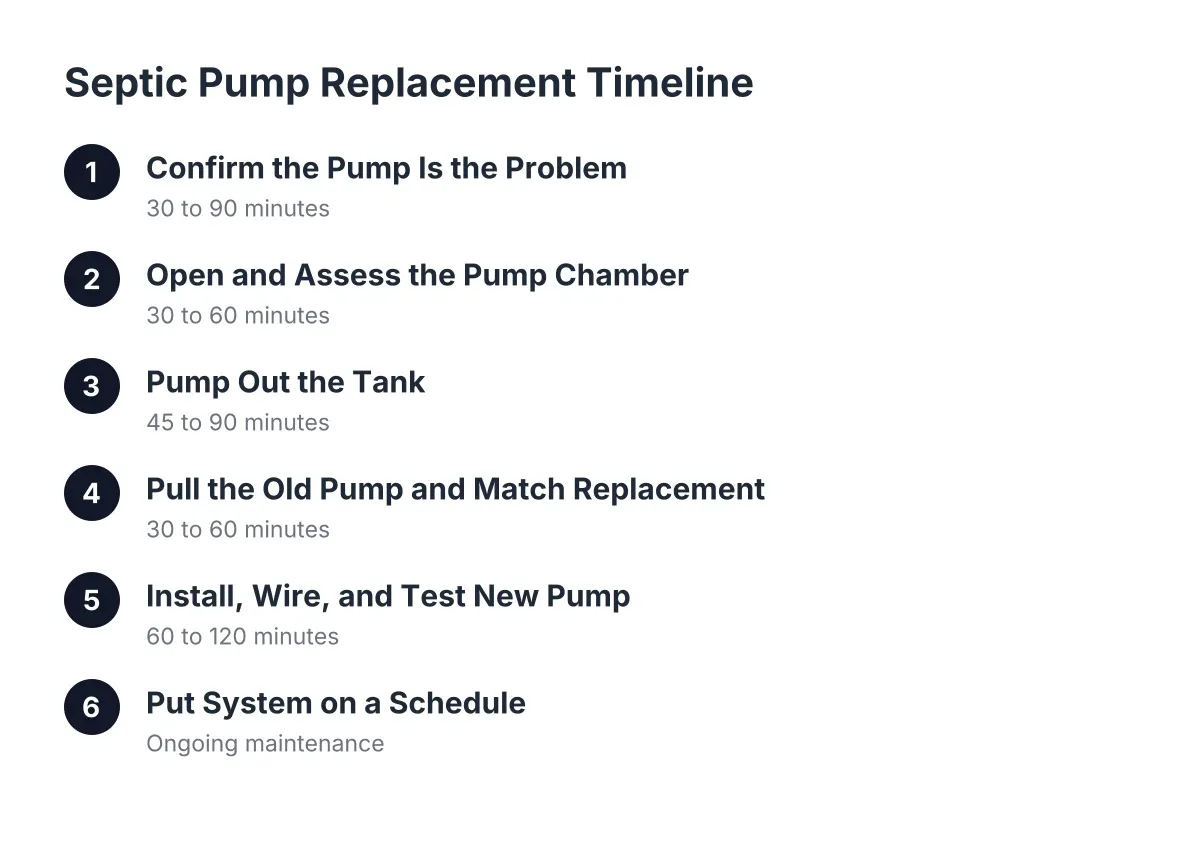
Septic Tank Pump Replacement Timeline: How Long the Job Takes Start to Finish
When a septic pump dies, the clock matters. Tenants are calling about a backup, or your own drains have slowed to a crawl, and you need to know how long the septic pump replacement timeline actually takes. Here is the short answer: the on-site work usually runs two to five hours, but the full timeline from first phone call to a working system can stretch from one day to a week depending on diagnosis, pump availability, and whether the tank needs a pump-out at the same time.
This guide walks through the job step by step, with realistic time windows for each stage. If you manage rental homes in Fontana, Bloomington, or Jurupa Valley on septic, this is the timeline you should hold any septic company to.
Step 1: Confirm the Pump Is Actually the Problem (30 to 90 Minutes)
Do not assume the pump failed just because water is backing up. Slow drains can come from a full tank, a clogged line, a tripped breaker, or a stuck float switch. A good septic tank inspector starts at the electrical panel, checks the alarm and floats, and listens for the pump before condemning it.
For example, say a landlord gets a tenant call about a sewage smell near the back fence. A crew that shows up and tests first might find a float switch tangled in its own cord, a 30-minute fix. A crew that skips diagnosis might sell a full pump swap nobody needed.
Budget 30 to 90 minutes for this step. The time depends on how easy the pump chamber is to access and whether the lid is buried.
What Happens When a Septic Tank Pump Fails: The Replacement Timeline
Ignoring a failing septic pump leads to sewage backing up into the house or pooling in the yard, because the effluent has no way to reach the drain field. Wastewater sits in the tank and chamber until it overflows. For a rental, that can escalate into a habitability complaint fast; for any homeowner, it means a bigger repair bill.
According to the U.S. Environmental Protection Agency, repairing or replacing a failed conventional system runs $5,000 to $15,000, while routine maintenance costs $250 to $500 every three to five years. A dead pump that gets ignored is one of the common paths from the small number to the big one.
Step 2: Open and Assess the Pump Chamber (30 to 60 Minutes)
Once the crew confirms the pump is the issue, they open the pump chamber or tank access. If the lids are at grade with risers, this takes minutes. If the lids are buried under a foot of soil, add digging time, sometimes 30 to 45 minutes of shovel work.
In addition, the crew checks the condition of the chamber itself. They look at the discharge pipe, the check valve, the float tree, and the wiring. Corroded fittings or a cracked union found now gets replaced during the same visit instead of causing a second trip.
Step 3: Pump Out the Tank Before the New Pump Goes In (45 to 90 Minutes)
Here is the step many homeowners do not expect. When a new pump goes in, there is a good chance the septic tank needs a pump-out at the same time. Old sludge and floating solids can wash into the chamber and damage a brand-new pump within months. Pumping first protects the new equipment.
A standard pump-out on a residential tank takes 45 to 90 minutes. San Bernardino County's minimum capacity table calls for a 1,000-gallon tank on a 3-bedroom home and 1,500 gallons for a 5-to-6 bedroom home, according to the San Bernardino County Department of Public Health. Larger tanks take longer to empty, and if the truck's capacity is smaller than the tank, the operator has to make a disposal run mid-job, which can add an hour or more.
One more thing worth knowing: the pumped waste does not get processed on site. It is hauled by truck to a sewage treatment plant for disposal, according to the New Hampshire Department of Environmental Services. And after a pump-out, the tank refills with water within days. That is normal; incoming household water displaces what was removed. It does not mean the job failed.
Step 4: Pull the Old Pump and Match the Replacement (30 to 60 Minutes)
Next, the crew disconnects the discharge line, unplugs or unwires the pump, and lifts it out of the chamber. Effluent pumps sit in wastewater for years, so fittings are often corroded. Expect some wrestling with unions and check valves.
Matching the replacement correctly matters more than speed here. The new pump should match the original's specs, not an arbitrary upgrade:
- Same flow rate, so the drain field receives doses it was designed for
- Same horsepower, so the pump is not oversized for the discharge line
- Same voltage, so it works with the existing circuit and controls
- Compatible float switch setup, so on, off, and alarm levels stay correct
This is where the timeline can split. A crew that carries common effluent pumps on the truck can keep moving. A crew that has to order the pump turns a half-day job into a two-to-five-day wait, and supply disruptions can stretch lead times further than anyone likes.
Step 5: Install, Wire, and Test the New Pump (60 to 120 Minutes)
Installation is the heart of the septic pump replacement timeline. The crew sets the new pump in the chamber, connects the discharge piping and check valve, secures the float switches at the right heights, and makes the electrical connections. On systems with a control panel and alarm, they verify the alarm float triggers before the chamber can overflow.
Then comes testing. A proper test runs the pump through at least one full cycle: fill the chamber, watch the pump kick on at the right level, confirm it moves water to the drain field, and verify it shuts off cleanly. Skipping the test to save 20 minutes is how callbacks happen.
Therefore, plan on one to two hours for this step. Backfilling around lids and cleaning up the work area adds a little more.
Step 6: Put the System on a Schedule So This Doesn't Repeat (Ongoing)
A new pump buys you years, but only if the tank gets pumped on schedule. Regular pumping is the single most important thing an owner can do to extend the life of a septic system. For an active family of four, pumping every two to three years is generally advisable, according to Penn State Extension. Rental homes with heavy occupancy often land at the shorter end of that range.
For a landlord with three septic properties, the practical move is simple: put all three tanks on one recurring pump-out and inspection schedule with the same local septic company. You get predictable, documented maintenance costs for accounting, and you stop learning about problems from tenant calls. While the system is open, also check for water waste; a single running toilet can send as much as 200 gallons per day into a septic system, according to the U.S. Environmental Protection Agency, and that constant load shortens pump life.
Common Timeline Questions About Replacing a Septic Pump
How long does septic pump replacement timeline work?
Replacing a septic tank pump takes about two to five hours of on-site work when the crew has the right pump on hand. That covers diagnosis, opening the chamber, pulling the old pump, installing and wiring the new one, and testing a full cycle. Add 45 to 90 minutes if the tank needs a pump-out first, and one to five days if the pump has to be ordered.
Can you replace a septic tank pump yourself or do you need a professional?
A mechanically capable homeowner can swap a like-for-like effluent pump, but the job involves raw sewage, confined-space hazards, electrical work near wastewater, and float settings that protect the drain field. Getting the specs or float heights wrong can flood a leach field, and that repair costs far more than the service call. For anything beyond a direct swap, or any work touching the tank or drain field itself, bring in a professional; installer work is a licensed trade in most places, with exams covering soil types, percolation, and local rules, according to the New Hampshire Department of Environmental Services.
How often do septic tank pumps need to be replaced in Fontana?
Effluent pumps in Fontana-area systems commonly last 7 to 15 years, depending on quality, usage, and how well the tank is maintained. A tank that goes too long between pump-outs sends solids into the chamber and wears the pump early. Heavy household water use, common in full rental homes, also shortens the span. Regular septic system inspection catches a weakening pump before it fails on a holiday weekend.
The Bottom Line on the Replacement Timeline
Suppose everything lines up: the crew diagnoses the pump in the morning, has a matching effluent pump on the truck, pumps the tank, and installs and tests the replacement by mid-afternoon. That is the best case, one working day. The realistic range runs from one day to about a week when a pump has to be ordered or access needs excavation.
The variable you control is scheduling. Owners who keep tanks on a regular pump-out and inspection cycle rarely face the emergency version of this job; the cost of septic pump replacement and the timeline are lower when the failure is caught early instead of discovered through a backup. For Fontana-area homes and rentals on septic, that routine is cheaper than any repair it prevents.
If you need septic tank pumping, Fontana Septic can help.
Related guide: septic tank pump replacement — Complete Guide
Prefer to talk it through? Call (909) 316-2368 — a quick call is usually the fastest way to get a straight answer for your situation.