
What Happens If You Delay Septic Tank Pump Replacement? Risks and Real Costs
If your septic system runs on a pump and that pump is failing, the question is not whether to replace it. The question is what happens if you delay replacing your septic pump—the consequences of waiting before acting on repairs to avoid expensive damage down the line. Understanding the risks of delaying septic pump replacement helps homeowners and builders make timely decisions. A pump-assisted system has no backup plan; when the pump stops moving effluent, the tank keeps filling and the wastewater has nowhere to go but back toward the house or out onto the ground. This FAQ walks through the real consequences of waiting, written for Fontana homeowners and builders who need a straight answer before the problem gets expensive.
What happens when you delay replacing a failing septic pump?
Delaying replacement of a failing septic pump lets the tank fill past its working level, which leads to sewage backups in the house, standing water over the tank, and damage to the drain field. The system can look fine for weeks, then fail all at once. The longer the delay, the more parts of the system get pulled into the failure.
Here is the chain of events in order:
- The pump weakens or stops, and effluent stops moving to the drain field or next chamber.
- The tank level rises above the outlet. Alarms trip, if the float switch still works.
- Solids and scum push into lines and baffles that were never meant to carry them.
- Wastewater backs up into the lowest drains in the house, or surfaces in the yard.
- The drain field takes on solids and starts to clog, which is the expensive part.
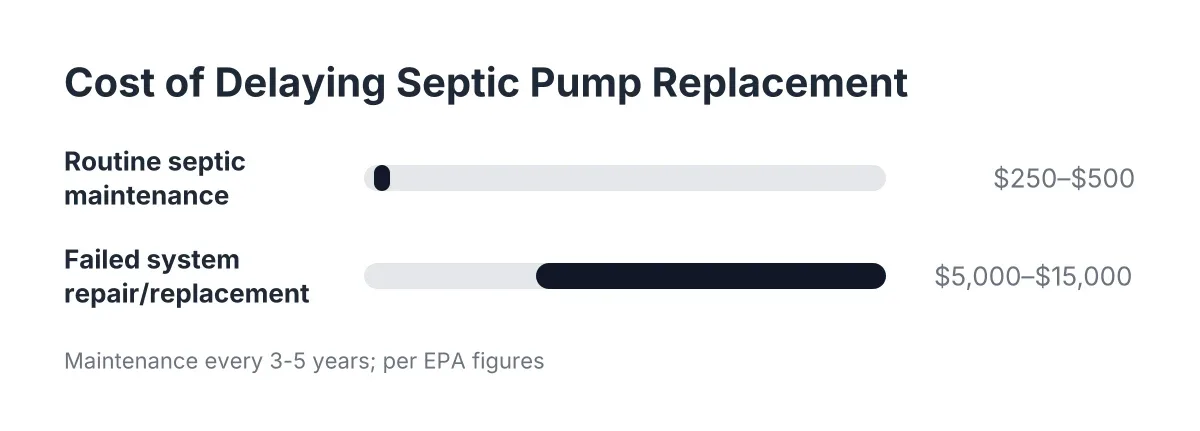
A dead pump is a repair. A clogged drain field is a project. According to the U.S. Environmental Protection Agency, routine septic maintenance runs $250 to $500 every three to five years, while repairing or replacing a failed conventional system runs $5,000 to $15,000. The costs of delaying septic pump replacement escalate rapidly; delay is how a few hundred dollars turns into five figures.
Can a failing pump damage the drain field?
Yes, a failing septic pump can ruin a drain field, and that is the single biggest risk of waiting. When the pump cannot move liquid out on schedule, the tank loses its ability to separate solids from liquid. Solids that should settle in the tank get carried out to the leach field instead.
Once solids reach the perforated pipes and gravel of the drain field, they clog the soil around them. According to the US EPA, a septic system works by letting solids settle in the tank while only liquid flows out to the drain field. A struggling pump breaks that separation. Soil clogged with solids does not recover on its own, and replacing a leach field is the costliest repair most septic owners ever face.
What are the warning signs before a pump fails completely?
Warning signs of a failing septic pump include a tripped high-water alarm, slow drains throughout the house, gurgling fixtures, wet or soggy ground over the tank or drain field, and sewage odors near the system. Any one of these means the clock is running. Two or more means stop waiting.
A clogged inlet baffle can mimic some of these symptoms, and according to the Washington State Department of Health, it is one of the first things to check when a line into the tank blocks up. That is one reason a septic system inspection before replacement matters: you want to replace the right part, not guess. A local septic tank inspector can confirm whether the pump, the float, the baffle, or the line is the actual failure.
Risks of delaying septic pump replacement during construction or sale
For a builder or new construction owner, a backup caused by delay can stall a county sign-off, a final inspection, or a closing. San Bernardino County health requirements govern tank sizing and system approval; the county's minimum capacity table requires a 1,000-gallon tank for a 3-bedroom home and 1,500 gallons for a 5-6 bedroom home, according to the San Bernardino County Department of Public Health. A system that is backing up is a system that fails inspection.
Suppose a small builder in an unsewered Fontana parcel has a final walkthrough scheduled in two weeks, and the lift pump on the model home starts short-cycling. In that scenario, replacing the pump now is a one-day line item. Waiting until effluent surfaces in the yard means a failed inspection, a county correction notice, and a construction timeline that slips while the schedule burns money. Delay costs more on a build than it does anywhere else, because every other trade is waiting behind the fix.
Will the tank need a pump-out when the new pump goes in?
Usually, yes. When a new pump goes in, the tank often needs a pump-out at the same time, because old sludge and solids can damage a new pump within weeks. Installing clean equipment into a tank full of accumulated solids is a fast way to be back where you started.
This is also why delay compounds. A tank that sat overfull while the old pump limped along has heavier sludge and scum layers than normal. The longer the wait, the more likely the job becomes septic tank pump replacement plus a full pump-out plus a baffle or filter cleaning, instead of a straightforward swap. For context on regular service, Penn State Extension advises that an active family of four generally should pump the tank every two to three years.
Can you limp along on a weak pump to save money?
No, running a weak septic pump to put off the cost does not save money; it transfers the cost to more expensive parts of the system. A pump that short-cycles, hums, or trips the alarm is already failing. Every day it runs in that state, it moves less effluent and lets more solids escape toward the drain field.
Think of it like skipping oil changes. The engine runs fine right up until it does not, and by then the damage is not in the part you were ignoring. Septic systems behave the same way; they can appear normal right up to a failure that cannot be reversed. Homeowners who report no problems after years of neglect are not lucky so much as early.
Consequences of delaying pump work on a new system under county review
Delaying pump work on a new system risks the county approval itself, plus warranty questions with the installer. New installations in San Bernardino County go through health department review, and a system that malfunctions during that window invites a closer look at the whole job, from the tank set to the drain field. According to University of Nebraska-Lincoln Extension, a percolation test must be performed before installation to confirm the soil drains properly; a pump failure that floods the field can undermine that soil before the system is even signed off.
In addition, pump problems on new construction sometimes trace back to installation issues rather than the pump itself. Fill around pipe penetrations must be compacted thoroughly to prevent settling and damage at the connection, a point noted by Onsite Installer. If a new system is acting up, get it inspected before the warranty conversation gets harder. This is a case where you should bring in a professional rather than troubleshoot it yourself, since the findings may matter for both the county and the installer.
How long can you realistically wait once the alarm goes off?
Once a high-water alarm sounds, the tank's reserve capacity before trouble starts is limited, and as a rough illustration it may amount to only a day or two of normal household use, with less cushion if laundry or guests push water use higher. That reserve is the system's only cushion. Cut water use immediately, and treat the alarm as a schedule-the-work-now signal, not a note for next month.
You can stretch the cushion a little:
- Stop laundry, dishwasher loads, and long showers until the pump is fixed.
- Fix any running toilet right away; a single leaky toilet can waste as much as 200 gallons of water per day, according to the U.S. Environmental Protection Agency, and all of it lands in the tank.
- Do not silence the alarm and forget it. The float tripped for a reason.
To be fair, not every alarm means a dead pump. A stuck float, a tripped breaker, or a clogged filter can set it off too, and those are cheaper fixes. An inspection sorts that out fast. What never works is silence and hope; the question of what happens if you delay always has the same ending, just with a bigger invoice attached.
The short version
A failing septic pump is a contained problem for a short window. Delay turns it into backups, a stressed or ruined drain field, failed county inspections, and a repair bill that can run ten times the cost of acting early. For a Fontana homeowner, that means acting on the first alarm or slow drain. For a builder on a 2026 permit timeline, it means treating pump trouble like any other critical-path item: fix it now, because everything downstream is waiting on it.
If you need septic tank pumping, Fontana Septic can help.
Prefer to talk it through? Call (909) 316-2368 — a quick call is usually the fastest way to get a straight answer for your situation.